Beyond stability: Metastability and metaffordance
Paul Treffner & Scott Kelso (2026; in progress)
Or simply jump to our ecological formulation!
Introduction
This essay develops a proposal that Kelso set out in a 2026 letter. The proposal is that the transition from an affordance to a metaffordance requires metastability, and more specifically the metastable brain~mind. We argue that the proposal holds, and that it reaches further than it first appears. Metastability is a precondition for metaffordance and also its dynamical signature.
We also ask where that metastability lives. In Kelso's account, mind is not equated with brain. Brain~mind is a complementary pair, set within the brain-body-environment system (Kelso and Engstrøm, 2006). The remnants a metastable system moves among are remnants of coordinations with the world. The metastability that matters for metaffordance therefore belongs to the organism-environment coupling as much as to the brain~mind. Earlier work on long memory during balancing points the same way (Treffner and Kelso, 1999).
The argument runs in seven steps. It considers the two meanings of "meta", what metastability is, how it meets Turvey's dispositional account of affordances, how choosing can be understood as resonance, how active stabilisation complements metastability, where metastability lives, and how the terms that break symmetry can be named for affordances.
Two meanings of meta
The two words use "meta" differently, and seeing how they meet is the first step of the argument.
In metaffordance, meta means higher-order, an affordance about affordances, and for creating, modifying, discovering or coordinating them. A pencil affords grasping, but as a metaffordance it opens writing, drawing and communication. The move is upward, from one level of possibility to the level that generates possibilities.
In metastability, as Kelso uses it, meta (from the Greek, μετά) means beyond. A metastable system has moved beyond stability. It has no stable states left, only tendencies. The move is outward, past the edge of an attractor.
Both words take the same Greek prefix in different senses. We propose that these are one move seen from two sides. A system held in a deep attractor is captured by one affordance and cannot take up others. A system with no structure at all cannot commit to anything. Only a system that has gone beyond stability, yet still feels the pull of its former stable states, can hold several affordances in view and move among them. Going beyond stability is what makes the higher order available.
What metastability is
Metastability is the regime of coordination dynamics in which no stable coordination states remain, yet the system still dwells near where they used to be. It comes from the extended Haken-Kelso-Bunz (HKB) model of relative phase (Kelso, DelColle and Schöner, 1990):
φ̇ = δω − a sin φ − 2b sin 2φ + √Q ξt
Here φ is the relative phase between two components, a and b set the coupling, Q scales the noise, and δω is the difference between the components' natural frequencies. With δω at zero, the model has two stable states, in-phase and anti-phase. As δω grows, the symmetry breaks and the stable states drift. Past a critical value they disappear in saddle-node bifurcations.
They do not vanish without a trace. The flow slows where the fixed points used to be, leaving what Kelso calls a remnant or ghost of an attractor. Relative phase lingers near such remnants, slips away, and is caught again. Two tendencies act at once, an integrating tendency for the parts to move together and a segregating tendency for each to express its own dynamics. Neither wins. These instabilities do useful work. They provide "a natural switching mechanism without any switches at all", and the variability that accompanies them is a source of flexibility (Kelso, 2010).
One clarification matters for what follows. In physics, "metastable" usually means a long-lived local minimum, a state that is stable but not the most stable. Kelso's sense is close to the opposite. The system has no minima at all, only places where it tends to linger. A physicist's metastable system is stuck in a well. Kelso's is always on the move and never captured. The argument here uses Kelso's sense throughout.
Dispositions: Where Kelso meets Turvey
Kelso's letter describes metastability as "a field of possibilities that becomes dispositional until choices (such as a resonant state) are made." The word dispositional carries a lot of weight in that sentence.
Turvey (1992) gave affordances a dispositional ontology. An affordance is a property of the environment that is realised only when it meets a complementary property of an animal, its effectivity. Neither disposition shows itself alone. A step affords climbing only to a creature whose legs can climb it.
Turvey's account says what affordances are but says little about how an animal moves among them. Coordination dynamics provides that. Put the two together and the picture is this. The environment presents a field of dispositional affordances. The animal's coordination dynamics, when metastable, stay in contact with several of them at once. A choice is the moment one affordance and its matching effectivity lock together.
Chemero (2003) objected that affordances are better treated as relations than as dispositions. Metastability suggests a way through that dispute. Before a choice, the affordance is dispositional, a tendency the system feels but has not realised (held open by metastability). At the choice, it becomes relational, an actual coupling between animal and environment. Both descriptions are correct, at different moments of the same dynamics.
For Chemero, a metaffordance would then be a relation whose realisation changes other relations, that is, an opportunity to alter the layout of affordances. Chemero, Klein and Cordeiro (2003) define events as changes in the layout of affordances; a metaffordance is then an affordance for events in their sense. Picking up a pencil to write realises one relation between hand and object and also creates new relations, to a page, a reader, a message not yet written. In dynamical terms, a metaffordance is the capacity to reshape the field of relations while staying in the metastable regime that keeps that field open.
Here is an example of how a metaffordance - a skateboard - changes the field of possibilities for a turtle:

Choosing as resonance
If a choice is a resonant state, then the space of possible choices has a known structure from pure mathematics and number theory, namely the Farey sequence arranged as the Farey tree. The same ordering reappears in the physics of coupled oscillators, where the regions of mode-locking are ordered by the Farey tree. This fits Michael Levin's hypothesis that living systems draw on a space of forms or patterns, ranging from mathematical facts to kinds of minds, that comes neither from genetics nor from the environment (Levin, 2026a, 2026b).
Studies of rhythmic coordination (Treffner and Turvey, 1993) found that frequency ratios between limbs are not all equally available. Simple ratios such as 1:1 and 1:2 are wide and stable; complex ratios such as 3:5 are narrow and fragile. The Farey tree orders these ratios in a hierarchy, and the width of each ratio's mode-locking region (its "Arnold tongue") shrinks further down the tree (see also Kelso and deGuzman, 1988; deGuzman and Kelso, 1991).
deGuzman and Kelso (1991) found the same ordering when one finger was driven by a motor and the other had to keep a different frequency. Low-order ratios such as 2:1 and 3:1 were less variable than higher-order ones, and the higher-order ratios slid toward a simpler neighbour, 4:3 toward 1:1 and 5:2 toward 3:1, sometimes within a single trial. Relative phase locked near in-phase or anti-phase, wandered off, and locked again. They modelled this with a sine circle map given built-in phase attraction, in which the width of each Arnold tongue is set by the balance between the external drive and the system's own pull toward in-phase and anti-phase. A pattern is harder to perform the narrower its tongue, so "errors" are pulls toward wider tongues. The width of a tongue is therefore a property of the coupling between organism and driver, not of either alone, and in their words ordered and irregular behaviour "may arise from the same dynamics depending on where the system lives in parameter space".
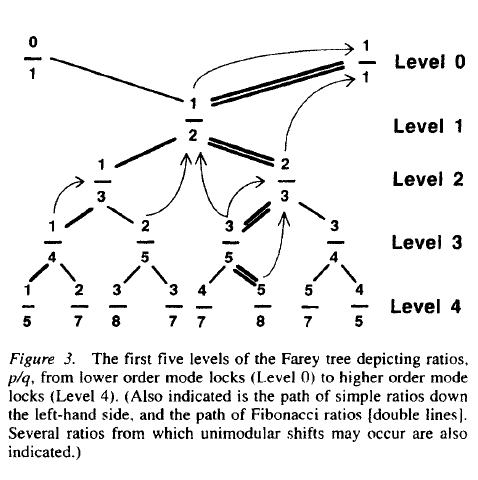
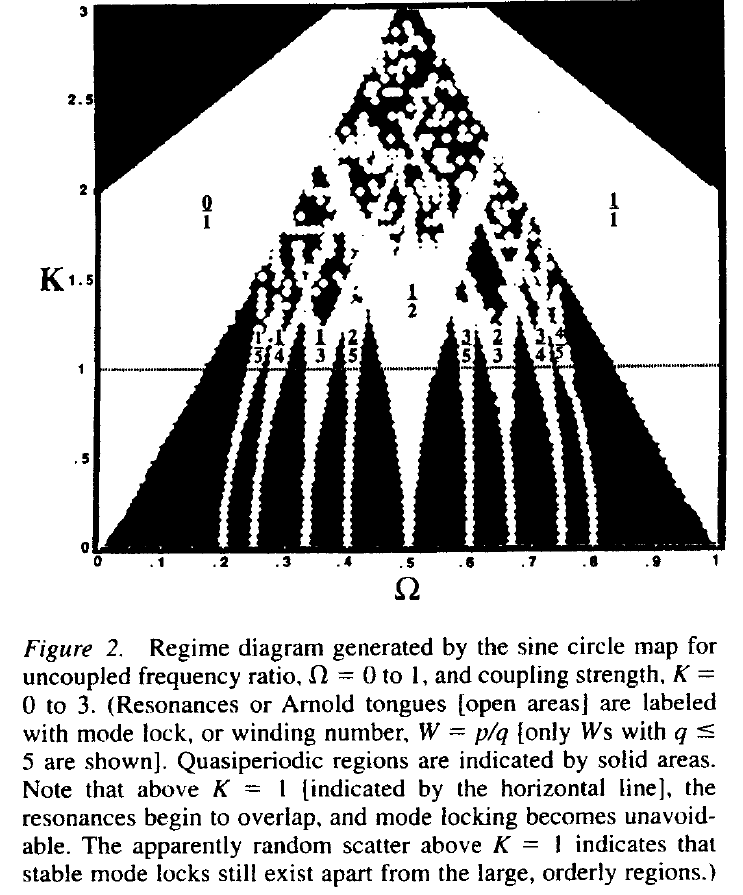
This gives the "field of possibilities" a concrete form. The options are the mode-lockings. Their stabilities are graded by the tree. A metastable system is one that is not locked into any ratio but passes near several, dwelling longer near the wider tongues. A choice is a mode-lock (see also Consciousness as a field of possibilities).
On this reading, a metaffordance is an opportunity to change the landscape itself. Trying harder, choosing a ratio, or switching between ratios all move the system across a landscape that already exists. A metaffordance alters the equation of motion. Learning does this, by one of two routes that depend on what the learner brings to the task (Kostrubiec, Zanone, Fuchs and Kelso, 2012). Where the new pattern lies between existing attractors, learning creates a new attractor, a bifurcation that adds an option to the landscape (Zanone and Kelso, 1992). Where it lies close to an existing attractor, that attractor shifts toward the new pattern without any being added. Either way the landscape changes, and the learner's prior landscape decides how. The same metaffordance can therefore reshape different learners' landscapes in different ways.
The two routes also differ in what lasts. Learners who took the bifurcation route could recall the new pattern later, while those who took the shift route could not, because the shifted attractor drifted back toward its original position once practice stopped. Only the bifurcation route changed the landscape for good. Tools do it too. A skateboard changes a turtle's biomechanics (effectivities), and with them the attractors (affordances) available to it. The Farey ordering remains fixed by number theory, but the width of each tongue, the coupling strength at which it appears, and whether it can be reached at all are open to change. The landscape is specified by information such as relative phase and its fluctuations, which people can perceive (Zaal, Bingham and Schmidt, 2000). Metastability shows in the action itself. The coordination dwells near several resonances and escapes each one, captured by none. Attunement to the information that specifies them is what lets the actor use those tendencies.
The complement: Holding an unstable point
Metastability is one way of living near instability. Functional stabilisation is the other, and the two together cover more ground than either alone.
In studies of pole balancing (Treffner and Kelso, 1999; see also Foo, Kelso and de Guzman, 2000), the task was to hold a system at a point that is inherently unstable. Left alone, it falls. The person keeps it up through continuous small corrections, and the time series of those corrections shows long memory. The fluctuations are correlated across many time scales, a fractal signature of ongoing work.
The contrast with metastability is clear:
| Metastability | Functional stabilisation | |
|---|---|---|
| Stable states | None; only remnants | One, unstable without help |
| What the system does | Moves among former attractors | Stays on a knife-edge |
| Signature | Dwell and escape | Long memory in corrections |
| Role for metaffordance | Keeps options open | Holds a chosen option against collapse |
A mature metaffordance may need both. Metastability keeps the field of affordances open. Functional stabilisation lets the system commit to a fragile choice, such as a complex rhythm or a precarious balance, and keep it going without falling back into the nearest simple attractor. The long memory found there was a property of the person-plus-task system as a whole. That leads directly to the question in the next section.
Where metastability lives: Brain~mind and the coupling with the world
Kelso's letter locates the transition to metaffordance in the metastable brain~mind. This is not a reductive claim. In Dynamic Patterns (Kelso, 1995), mind and brain are described by the same coordination dynamics, and mind is treated as a pattern in those dynamics. In The Complementary Nature (Kelso and Engstrøm, 2006), the tilde in brain~mind marks a complementary pair, in which brain and mind are distinct but inseparable aspects of one process. We place the metastable brain~mind within the brain-body-environment system, and welcome Kelso's link between metastability and metaffordance because it brings in the brain aspect of that system.
Mind, then, is not brain, and the system of interest is brain-body-environment. What remains is a question of emphasis, namely where the metastability that matters for perceiving and acting on a metaffordance primarily lives.
The answer is that it lives in the coupling. An affordance is, by definition, a fit between animal and environment. The remnants of attractors that a metastable system moves among are remnants of coordinations with the world, such as a hand with a pencil, a body with a slope, a finger with a jaw, or two people clapping in time. The brain~mind is a metastable participant in those coordinations, often the decisive one, but the pull of each option comes from the whole coupled system. The pencil's metaffordance for writing does not exist for a brain~mind that has never met pencils.
Metastability in this context was first observed and modelled by Kelso and colleagues in the late 1980s, even though its significance had yet to be realised. Kelso, DelColle and Schöner (1990) studied people coordinating finger movements with a periodic auditory stimulus, a coupling between organism and environment, and it was in that perception-action setting that the extended HKB model with its detuning term was first developed.
The balancing result makes the same point empirically. The long memory in the corrections was a property of the organism-task system as a whole. If that holds for functional stabilisation, it should hold for metastability too.
The transition from affordance to metaffordance requires metastability of the brain~mind~body~environment system, with the metastable brain~mind as one essential participant. In the notation of coordination dynamics, the tilde simply runs further.
Naming the detuning: Two routes to broken symmetry
To make metastability do real work for affordances, the terms of the model need identifying in an affordance landscape, especially the term that breaks symmetry. Work on handedness shows that there are two such terms, not one, and that they can be told apart.
Two routes
The asymmetric form of the HKB equation (Treffner and Turvey, 1995) adds anisotropic coupling to the detuning term:
φ̇ = Δω − a sin φ − 2b sin 2φ − c cos φ − 2d cos 2φ + √Q ξt
- Detuning (Δω) breaks symmetry through a difference between the components themselves. In bimanual rigid pendulum swinging each pendulum's natural frequency was controlled by pendulum length and mass (Treffner and Turvey, 1996). In speech-hand coordination, the jaw and finger differ in natural frequency (Treffner and Peter, 2002).
- Anisotropic coupling (c and d) breaks symmetry even when Δω = 0 and the components are the same. Right-handers show a small right-hand lead with identical pendulums, and left-handers the reverse (Treffner and Turvey, 1995, 1996). Attention modulates this term, and directing attention to the preferred hand increases the lead (Amazeen et al., 1997; Riley et al., 1997). In speech-hand coordination, attention and intention were captured in c and d, which grew as movement frequency increased (Treffner and Peter, 2002).
Two signatures
The routes leave different fingerprints. Detuning shifts an attractor and makes it more variable. As Δω grows, the shifted state weakens until it disappears in a saddle-node bifurcation. Anisotropic coupling can shift an attractor and make it less variable. Amazeen et al. (1997) found that attention to the preferred hand increased the phase shift while SD(φ) decreased, which the standard model does not predict but the d term does.
The affordance case
This gives two names for the affordance landscape.
- Affordance detuning is the mismatch between an animal's action capabilities and the environment, measured as distance from an action boundary. Warren (1984) showed that stair climbing has a critical riser-to-leg-length ratio, πc. Detuning can be defined as π − πc. Affordance boundaries also show hysteresis, the signature of a bifurcation. The switch from one-handed to two-handed grasping depends on whether object size is increasing or decreasing (Lopresti-Goodman, Turvey and Frank, 2011).
- Intentional anisotropy is a bias toward one affordance that comes from attention or intention, not from fit. On the evidence of the handedness work, it can shift the system toward a choice while stabilising it.
The prediction follows directly. When an animal is biased toward one of several affordances, the source of the bias can be diagnosed. A shift with more variability points to affordance detuning, and a shift with less variability points to intentional anisotropy.
Rival accounts
Other models also describe dwell-and-escape behaviour. Rabinovich and colleagues (2008) propose transient dynamics along heteroclinic channels, and work on neural criticality explains flexibility through poise near a phase transition. Kelso's account makes a specific claim that separates it from these. Near the remnant of a saddle-node bifurcation, dwell time should grow as Δω approaches its critical value from above, following the scaling law for such bifurcations.
The approach has a record of such tests. As the HKB model approaches a transition, it predicts that recovery from a small perturbation slows down and that fluctuations in relative phase grow. Experiments confirmed both, years before these "early warning signals" became a topic in climate and ecology (Kelso, 2010).
A neighbouring programme: Ecological neuroscience
A new consortium in systems neuroscience has put affordances at the centre of its agenda. The Simons Collaboration on Ecological Neuroscience (SCENE) proposes that brains may prioritise controllable latent variables, "generalizing the categorical 'affordance' to become a continuous 'controllability'" (Angelaki et al., 2026). It sets this hypothesis beside two familiar ones, that brains encode every cause of their sensory input and that they encode only what predicts reward. For SCENE a task is ecological when it has a closed perception-action loop, sequences of actions with delayed reward, and partial observability. Its formal tool is the partially observable Markov decision process (POMDP), in which an agent acts on beliefs about a world it cannot fully see.
Much of this sits close to the argument here. SCENE defines its tasks by the organism-environment coupling they embody. Its planned experiments include objects with novel affordances, young children whose action repertoire is changing fast, and "interacting or hierarchical affordances", where one action gates others, as when turning a door-knob opens a new path. That last case is a metaffordance in all but name. It is an affordance whose realisation changes the layout of other affordances, an event in the sense of Chemero, Klein and Cordeiro (2003). SCENE also names a measure that could put the test in the coda below into numbers. Empowerment is a formal measure of an agent's potential to influence and control its environment, and a metaffordance that keeps the field of possibilities open should raise it.
The two programmes part company on two points. First, SCENE sets aside Gibson's direct perception and his aversion to representation, and treats affordances as controllable properties of a world state that the brain must infer and hold in its belief states. The account here places them in the coupling, with the brain~mind as one participant. Since the POMDP loop runs through the world as well as the brain, the gap may be smaller than it looks. Second, SCENE's framework describes which variables a brain represents. It says little about how the system moves between options, holds a fragile choice, or switches. SCENE lists dynamical systems among the work it builds on, but metastability and coordination dynamics do not appear in it.
Coordination dynamics can supply that piece. If an affordance is a controllable variable, then choosing among affordances is a transition in the dynamics, and the signatures set out above apply. Dwell times near remnants, critical fluctuations before a switch, and the variability test that separates affordance detuning from intentional anisotropy can all be measured in the navigation and manipulation tasks SCENE plans to run. The two approaches meet at the affordance. SCENE asks what the brain represents, and coordination dynamics asks how the brain~mind~body~environment system moves among what is represented.
Conclusion
The proposal we opened with holds, and it goes further than a precondition. Metastability is what having a metaffordance looks like from the inside of the dynamics, a system that has gone beyond stability, stays in contact with several affordances, and chooses by resonance. From the outside, it looks like skilled exploration (E. J. Gibson, 1988), an animal that tries, hesitates, switches and improvises, leaving measurable traces in dwell times and variability, and a world whose layout of affordances changes as a result.
The pieces fit together. Turvey's dispositions are the options. The Farey tree (or an analogous mathematical space) orders them. Metastability keeps them open. Functional stabilisation holds a fragile choice once it is made. And all of it belongs to the brain~mind~body~environment system, with the metastable brain~mind as one essential participant.
The two routes to broken symmetry complete the picture. Affordance detuning opens the metastable field; intentional anisotropy selects within it without tipping the system into instability. A metaffordance has both control parameters available. This brings intention into the dynamics in formal terms, as a coupling term within the system, and it yields a prediction that can be tested with the methods coordination dynamics already has. The variability that accompanies a bias toward an affordance reveals whether that bias comes from fit or from intention.
Put in ecological terms, the argument comes down to one formulation:
The organism directly perceives affordances and metaffordances by detecting the information that specifies them. For metaffordances this information is higher-order: it specifies not a single possibility but the stability, history and resonances of the patterns of coordination from which possibilities arise. Acting on what it perceives, the organism transforms both itself and its environment, reshaping the generative conditions from which further affordances and metaffordances emerge.
The resonances ordered by the Farey tree, the long memory of functional stabilisation, and the reorganisation of the attractor landscape through learning are what that higher-order information consists of. Metastability is the condition under which it can be detected and acted on.
Details
A coordination pattern is characterised by a collective variable, such as relative phase, whose stable values form a landscape of attractors (Kelso, 1995). As a pattern approaches instability, its fluctuations grow and its recovery from perturbation slows. These critical fluctuations and critical slowing down specify that the layout of possibilities is about to change (Schöner and Kelso, 1988). Coordination also carries its history. Hysteresis means that what is possible now depends on the path taken to get here, and timing fluctuations in rhythmic coordination show long memory, with correlations persisting across many cycles (Chen, Ding and Kelso, 1997; Treffner and Kelso, 1999). Resonance describes how coordination settles into preferred frequencies and phase relations shaped by the physical properties of the limbs and the task (Treffner and Turvey, 1993), so that relationships persist and reappear even as the individual events change. Stability, history and resonance belong to the pattern, not to any single action, and they are what a metaffordance concerns.
Learning shows how interaction transforms the generative conditions. Zanone and Kelso (1992, 1997) found that learning a new coordination pattern does not simply add it to the repertoire. The whole attractor landscape is reorganised, and pre-existing patterns can be stabilised or destabilised. Kostrubiec, Zanone, Fuchs and Kelso (2012) showed that the route learning takes depends on the learner's intrinsic dynamics. Sometimes learning shifts an existing attractor, and sometimes a new one is created through a bifurcation. Either way, what changes is not one affordance but the field from which affordances emerge.
Coda: A test for metaffordances
If metastability is the signature of a metaffordance, it also gives a test for judging one. A good metaffordance keeps the field of possibilities open, leaving its user attuned to many options without capturing them in any one. A poor one deepens a single attractor.
Artificial intelligence makes the test urgent. It is the first metaffordance that acts back in the medium it came from, language, and so it takes part in the coupling instead of sitting on one side of it. That can widen what people perceive as possible. It can also narrow it, through habitual deference, homogenised thought, and skills that fade from disuse. What matters is whether AI keeps the brain~mind~body~environment system metastable or pulls it into one basin. That depends on design and use, which makes it an ethical question as much as a dynamical one (see Ethics; Artificial intelligence; Agentic AI).
References
Amazeen, E. L., Amazeen, P. G., Treffner, P. J., & Turvey, M. T. (1997). Attention and handedness in bimanual coordination dynamics. Journal of Experimental Psychology: Human Perception and Performance, 23, 1552-1560. Link
Angelaki, D. E., Batista, A., Fitzgerald, T., Kominsky, J. F., Lengyel, M., Mathis, A., Mathis, M. W., Moss, C. F., Niell, C. M., Noel, J.-P., Pitkow, X., Rothkopf, C. A., Savin, C., Stachenfeld, K., Suthana, N., Tolias, A., Ulanovsky, N., Wolpert, D., Wong, A., & Zimmermann, J. (2026). The Simons Collaboration on Ecological Neuroscience: Studying how the brain interacts with the world. Neuron. Link; PDF
Chemero, A. (2003). An outline of a theory of affordances. Ecological Psychology, 15, 181-195. Link
Chemero, A., Klein, C., & Cordeiro, W. (2003). Events as changes in the layout of affordances. Ecological Psychology, 15, 19-28. Link
Chen, Y., Ding, M., & Kelso, J. A. S. (1997). Long memory processes (1/fα type) in human coordination. Physical Review Letters, 79, 4501-4504. Link
deGuzman, G. C., & Kelso, J. A. S. (1991). Multifrequency behavioral patterns and the phase attractive circle map. Biological Cybernetics, 64, 485-495. Link
Foo, P., Kelso, J. A. S., & de Guzman, G. C. (2000). Functional stabilization of unstable fixed points: Human pole balancing using time-to-balance information. Journal of Experimental Psychology: Human Perception and Performance, 26, 1281-1297. Link
Gibson, E. J. (1988). Exploratory behavior in the development of perceiving, acting, and the acquiring of knowledge. Annual Review of Psychology, 39, 1-41. Link
Gibson, J. J. (1979). The ecological approach to visual perception. Boston: Houghton Mifflin. Link
Haken, H., Kelso, J. A. S., & Bunz, H. (1985). A theoretical model of phase transitions in human hand movements. Biological Cybernetics, 51, 347-356. Link
Kelso, J. A. S. (1995). Dynamic patterns: The self-organization of brain and behavior. Cambridge, MA: MIT Press. Link
Kelso, J. A. S. (2010). Instabilities and phase transitions in human brain and behavior. Frontiers in Human Neuroscience, 4, 23. Link
Kelso, J. A. S. (2012). Multistability and metastability: Understanding dynamic coordination in the brain. Philosophical Transactions of the Royal Society B, 367, 906-918. Link
Kelso, J. A. S., & deGuzman, G. C. (1988). Order in time: How the cooperation between the hands informs the design of the brain. In H. Haken (Ed.), Neural and synergetic computers (pp. 271-287). Berlin: Springer-Verlag. Link
Kelso, J. A. S., DelColle, J. D., & Schöner, G. (1990). Action-perception as a pattern formation process. In M. Jeannerod (Ed.), Attention and performance XIII (pp. 139-169). Hillsdale, NJ: Erlbaum. Link
Kelso, J. A. S., & Engstrøm, D. A. (2006). The complementary nature. Cambridge, MA: MIT Press. Link
Kostrubiec, V., Zanone, P. G., Fuchs, A., & Kelso, J. A. S. (2012). Beyond the blank slate: Routes to learning new coordination patterns depend on the intrinsic dynamics of the learner. Experimental evidence and theoretical model. Frontiers in Human Neuroscience, 6, 222. Link
Levin, M. (2026a). Ingressing minds: Causal, non-physical patterns in-form natural, synthetic, and hybrid embodiments. Philosophies, 11(5), 161. Link
Levin, M. (2026b). A short argument on Platonic space: Variable-agency patterns that in-form physics, biology, computer science, and cognitive science. Forms of life, forms of mind (blog), 31 March. Link
Lopresti-Goodman, S. M., Turvey, M. T., & Frank, T. D. (2011). Behavioral dynamics of the affordance "graspable". Attention, Perception, & Psychophysics, 73, 1948-1965. Link
Rabinovich, M., Huerta, R., & Laurent, G. (2008). Transient dynamics for neural processing. Science, 321, 48-50. Link
Riley, M. A., Amazeen, E. L., Amazeen, P. G., Treffner, P. J., & Turvey, M. T. (1997). Effects of temporal scaling and attention on the asymmetric dynamics of bimanual coordination. Motor Control, 1, 263-283. Link
Schöner, G., & Kelso, J. A. S. (1988). Dynamic pattern generation in behavioral and neural systems. Science, 239, 1513-1520. Link
Tognoli, E., & Kelso, J. A. S. (2014). The metastable brain. Neuron, 81, 35-48. Link
Treffner, P. J., & Kelso, J. A. S. (1999). Dynamic encounters: Long memory during functional stabilization. Ecological Psychology, 11, 103-137. Link
Treffner, P. J., & Peter, M. (2002). Intentional and attentional dynamics of speech-hand coordination. Human Movement Science, 21, 641-697. Link
Treffner, P. J., & Turvey, M. T. (1993). Resonance constraints on rhythmic movement. Journal of Experimental Psychology: Human Perception and Performance, 19, 1221-1237. Link
Treffner, P. J., & Turvey, M. T. (1995). Handedness and the asymmetric dynamics of bimanual rhythmic coordination. Journal of Experimental Psychology: Human Perception and Performance, 21, 318-333. Link
Treffner, P. J., & Turvey, M. T. (1996). Symmetry, broken symmetry, and handedness in bimanual coordination dynamics. Experimental Brain Research, 107, 463-478. Link
Turvey, M. T. (1992). Affordances and prospective control: An outline of the ontology. Ecological Psychology, 4, 173-187. Link
Warren, W. H. (1984). Perceiving affordances: Visual guidance of stair climbing. Journal of Experimental Psychology: Human Perception and Performance, 10, 683-703. Link
Zaal, F. T. J. M., Bingham, G. P., & Schmidt, R. C. (2000). Visual perception of mean relative phase and phase variability. Journal of Experimental Psychology: Human Perception and Performance, 26, 1209-1220. Link
Zanone, P. G., & Kelso, J. A. S. (1992). Evolution of behavioral attractors with learning: Nonequilibrium phase transitions. Journal of Experimental Psychology: Human Perception and Performance, 18, 403-421. Link
Zanone, P. G., & Kelso, J. A. S. (1997). Coordination dynamics of learning and transfer: Collective and component levels. Journal of Experimental Psychology: Human Perception and Performance, 23, 1454-1480. Link
Related ideas

Paul Treffner
metaffordance.com