Metaffordances and Consciousness
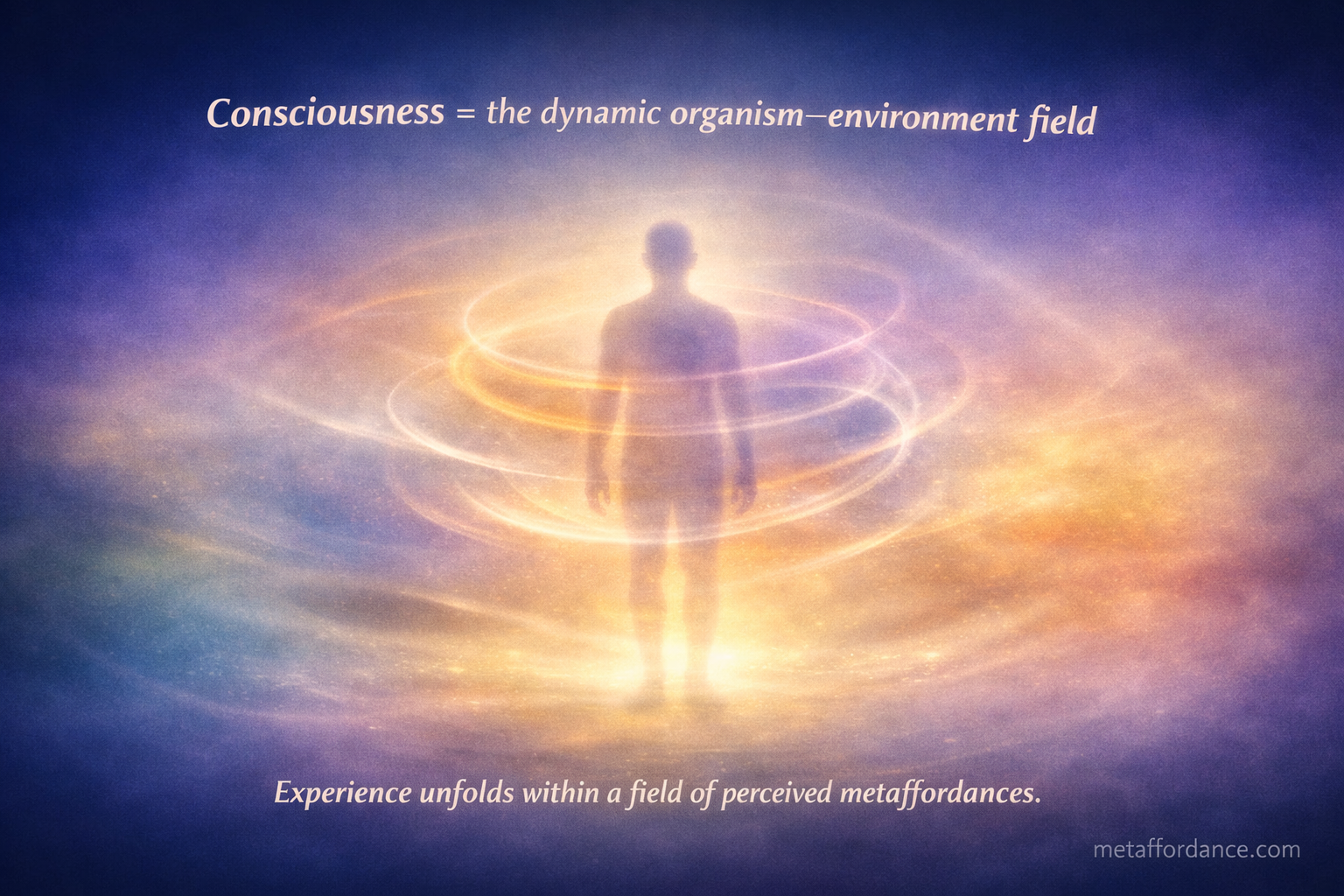
Experience and consciousness, from a metaffordance perspective, are not things located inside an organism that passively “represent” an external world. They emerge from ongoing engagement with a world structured by affordances and metaffordances—where what matters is not objects in isolation, but the possibilities for action, meaning, imagination, and transformation that those objects invite.
A chair is not just a physical object; it affords sitting, leaning, resting, perching. A face affords recognition, emotion, interaction. A painting on a wall affords viewing, interpretation, projection, memory, and emotional response.
Metaffordances extend this further. They are affordances that open access to other affordances. Metaffordances create possibilities layered on possibilities.
A novel affords entering imagined worlds, inhabiting perspectives, anticipating futures, revising memory, and experiencing emotion indirectly. A scientific theory affords new ways of seeing, new questions, new experiments, and new technologies. A ritual affords identity, belonging, transformation, and continuity with tradition.
Experience is the ongoing, embodied engagement of an organism with a structured field of affordances and metaffordances that span perception, action, memory, imagination, and culture.
Experience is not confined to the present sensory world. It integrates what is immediately available, what is remembered, what is anticipated, and what is imagined. The organism lives within a layered field of possibilities that is both physical and symbolic.
Consciousness is not a thing but a dynamic relation. It is the organism’s moment-to-moment awareness of this field of possibilities.
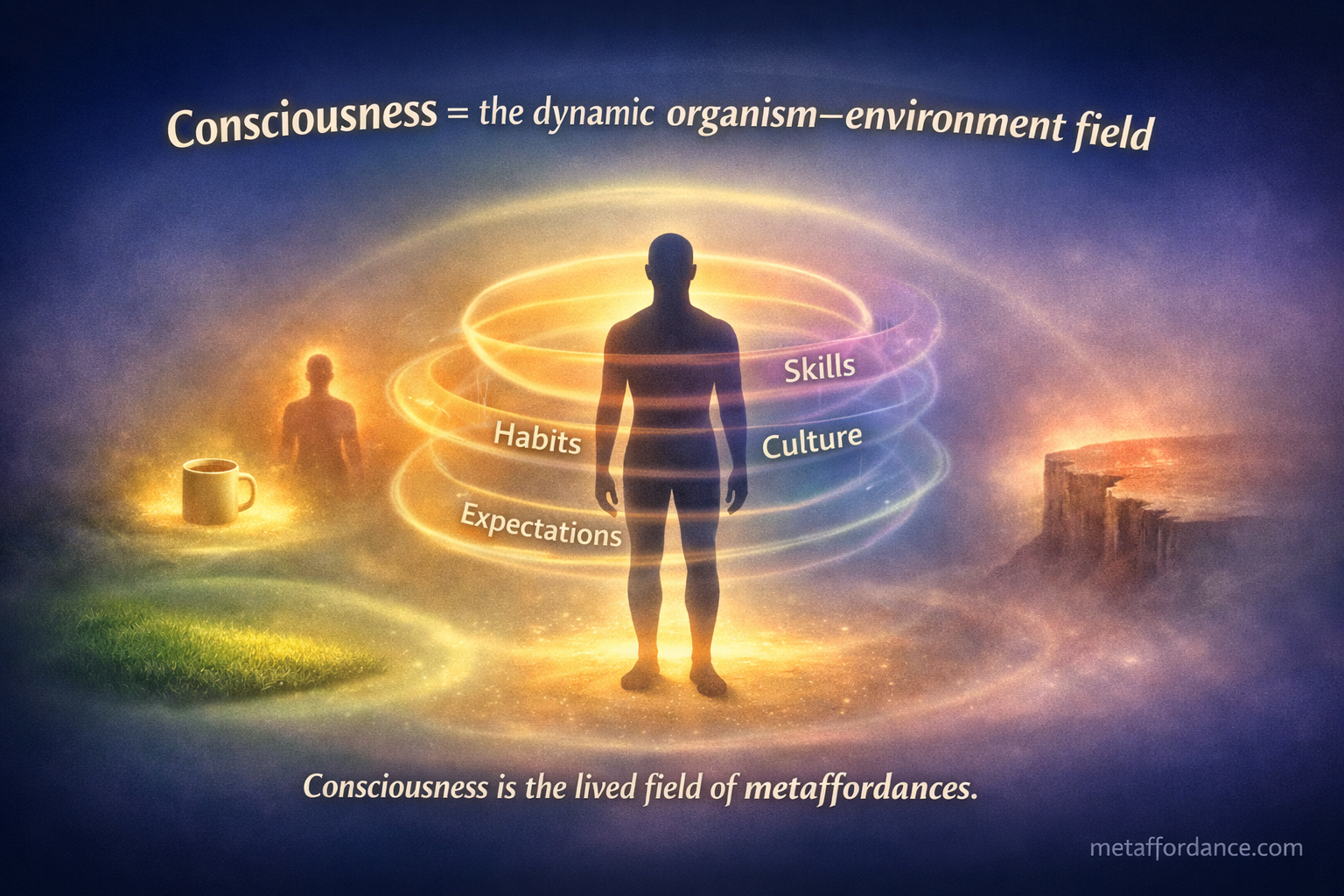
Consciousness is the lived awareness of a structured field of present, past, and possible affordances and metaffordances.
At any given moment, some affordances are directly actionable, others are inhibited, others are potential, and others are imagined or socially constructed. Consciousness is the structured space in which these possibilities are disclosed and navigated.
Self-consciousness arises when the organism becomes a metaffordance to itself. The self is not a static entity, but a point of reference within this field: “me-as-actor,” “me-in-the-future,” “me-as-seen-by-others.”
Imagination plays a central role. Imagined futures, remembered pasts, fictional worlds, scientific models, and cultural narratives are all metaffordances that structure present experience.
Morphic Resonance and Metaffordances
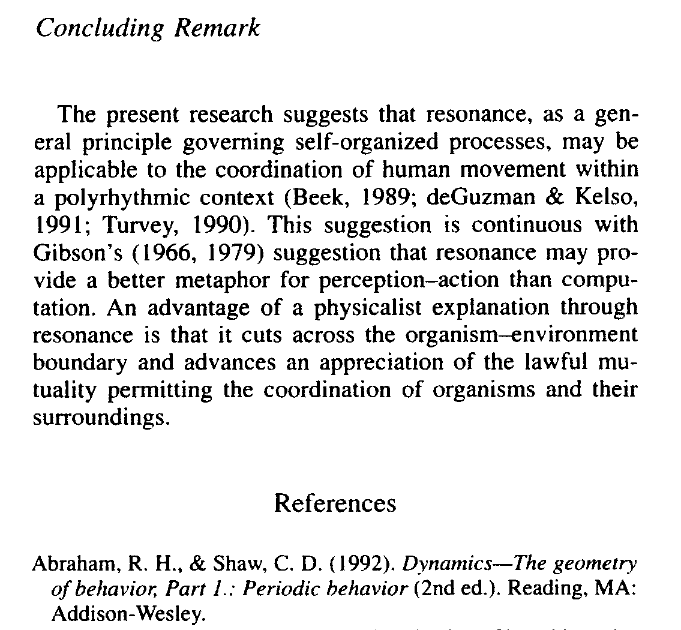
James Gibson (1979) described perception as a process of resonance to information.
This idea can be extended to metaffordances. The possibilities we perceive and act upon are not just in the
present moment; they are shaped by accumulated history. The environment is dense with traces of past
interaction, and these traces influence what we can perceive and do. My own research on human motor
coordination explicitly used the mathematical "higher order invariants" of ratios or "resonances" underlying
physical rhythm to explain how
people synchronise their bodies and limb movements
(Treffner & Turvey, 1993):
An interesting comparison arises with the idea of "morphic resonance", famously proposed by Rupert Sheldrake (a scientific champion of unconventional but consistent ideas). Morphic resonance suggests that patterns in nature are influenced by previous similar patterns, as if forms carry a kind of collective memory across time - Nature's "habits".
At first glance, both perspectives share an intuition: the present is shaped by accumulated past structure. However, they differ in mechanism and explanation.
Morphic resonance proposes a non-local influence between similar forms across time. Metaffordance theory instead explains persistence through ecological and historical structure.
- Environments retain traces of past action
- Cultures preserve knowledge in language, artefacts, and institutions
- Social practices are reproduced through repetition and learning
- Physical spaces are shaped by accumulated use
A path exists because people repeatedly walked it. A language persists because it is continually used. A scientific concept survives because communities continue to test and refine it.
What may appear as resonance with the past can be understood as engagement with a world already structured by accumulated interaction histories.
From this perspective, the environment is not neutral; it is historically shaped. Every affordance and metaffordance carries traces of prior activity.
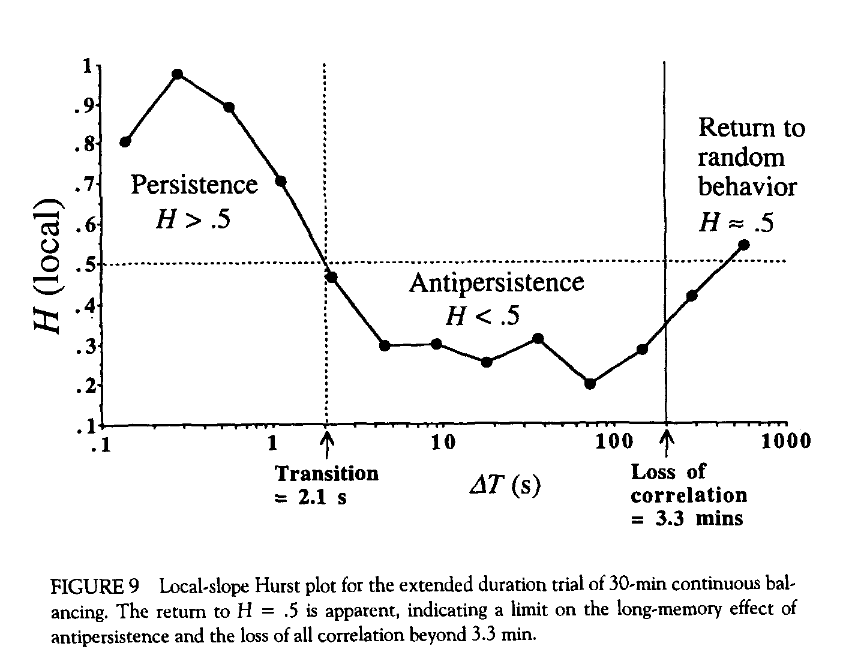
My research on "fractal time" provided evidence for the persistence of temporal structure across time scales in human movement, suggesting that the dynamics of action are influenced by the fractal, nested structure of events and long-term history - the persistence of the past in the present (Treffner & Kelso, 1999). For example, in human pole-balancing, the movements of the pole and the person are not random but exhibit fractal structure, extending over three minutes into the "past" (watch video of pole balancing). However, it is not necessarily a non-local (quantum mechanical) influence but the result of the nested, self-similar structure of temporally-extended events and interactions that shape behaviour over time. Behaviour is not a momentary response to the present but is a spatio-temporal event influenced by the history of interaction that has shaped the current field of affordances and metaffordances.
The appearance of “resonance with past forms” can be reframed as the continued action of historically accumulated metaffordances embedded in environments, practices, and cultural systems.
In this sense, experience and consciousness are ecological and historical events: the unfolding of an organism within a world dense with metaffordances accumulated over time.
References
Gibson, J. J. (1979). The Ecological Approach to Visual Perception. Psychology Press.
Treffner, P. J., & Kelso, J. A. S. (1999). Dynamic encounters: Long memory during functional stabilization. Ecological Psychology, 11, 103–137.
Treffner, P. J., & Turvey, M. T. (1993). Resonance constraints on rhythmic movement. Journal of Experimental Psychology: Human Perception and Performance, 19, 1221–1237.
Related ideas

Paul Treffner
metaffordance.com