Life, AI, and Self-organisation: Michael Levin
I was inspired to study psychology through the study of self-organisation and complex systems. I had also found Rupert Sheldrake's work on morphic fields and his ideas about morphogenesis. His experimental and theoretical work on morphic fields was fundamental to a proper understanding of the issues of form, function, and patterns - and where they come from (see "consciousness" here in Ideas). This was while studying for a PhD in learning, AI, and neural networks. But I left that when I discovered it had no acceptable concept of "information" other than the pre-structured inputs given to the network by a human.
I left because I had found a better concept of biological or ecological information - the "holy grail" of psychology research - James Gibson's theory of information-based perception and the ecological psychology approach to perception and action. I realised that this was the best way to study and understand behaviour and learning in the real world, and a promising way to understand intelligence in all organisms, not only in humans. I have been studying and writing about ecological psychology ever since, but have returned full-circle to my roots - exploring its implications for AI and self-organisation on general. I think ecological psychology is, by any standard, still the best theoretical and experimental framework for describing, explaining, and understanding behaviour of terrestrial organisms at the ecological scale of analysis (e.g., perception, action, information, affordances, etc.). However...
I recently discovered the fascinating work of Michael Levin, a developmental biologist who has been exploring the intersection of life, AI, fields, and self-organisation. Levin's research focuses on how biological systems can exhibit complex behaviours and organisational properties without explicit programming, drawing parallels to the way true AI systems might evolve. Levin is a developmental biologist at Tufts, known for work on bioelectric signaling in cells and tissues, regeneration, morphogenesis, and more recently "collective intelligence" — the idea that cognition-like problem-solving happens at fractal or multiple scales of biological organisation (cells, tissues, swarms), not just brains. He's also behind projects like "xenobots" and "anthrobots".
Michael Levin's work is extremely interesting for those studying ecological psychology (he even freely uses Gibson's concept of affordance to describe an organism's environment). His work highlights how complex behaviours can emerge from not only simple feedback rules and interactions (i.e., complex systems), but how actual biological systems can emerge from FIELDS - for example, simple electrical fields applied to a collection of skin cells in a petri dish. Below is a link to a recent interview with Michael Levin on the topic of life, AI, and self-organisation. I highly recommend watching it and others to gain insights into his perspective on these timely topics.
Environment and affordances
Levin even uses the term affordances as can be seen in the below video. It is worth watching in full as it shows clips of his work and experiments on "zenobots" - collections of frog skin cells that can self-organise into small clumps that can move in a coordinated manner. Levin is suggesting that affordances exist at multiple scales of biological organisation, not just at the scale of humans and animals. The environment provides affordances for all organisms, including their cells and tissues, and these affordances can be acted upon at their own level and scale of organisation. This is a challenging idea for ecological psychologists, I think, as it extends the perception-action cycle down to indefinitely small scales. It is also a key insight for ecological psychology, as it suggests that other researchers like Levin now agree and accept that the principles of multiscale coordination and perception-action are a foundational concept and principle for all living things. Gibson would be smiling.
"Psychology is primary and the basis of everything; physics comes later" (to paraphrase my PhD advisor, Mike Turvey). Of course this resonates with the work of Rod Swenson after he joined us at the University of Connecticut and developed his theory of the Law of Maximum Entropy Production as the primary driving force of all goal-directed perception-action systems (Swenson & Turvey, 1991; Swenson, 2023).
Video: Levin on how the environment of "affordances" defines the organism. The video starts at the appropriate time point for some context before he mentions affordances at 1:59:10:
The "light cone"
I wish to focus on one key idea he likes to use that he claims to have invented and introduced in 2019 - the cognitive light cone (ref: The Computational Boundary of a "Self": Developmental Bioelectricity Drives Multicellularity and Scale-Free Cognition).
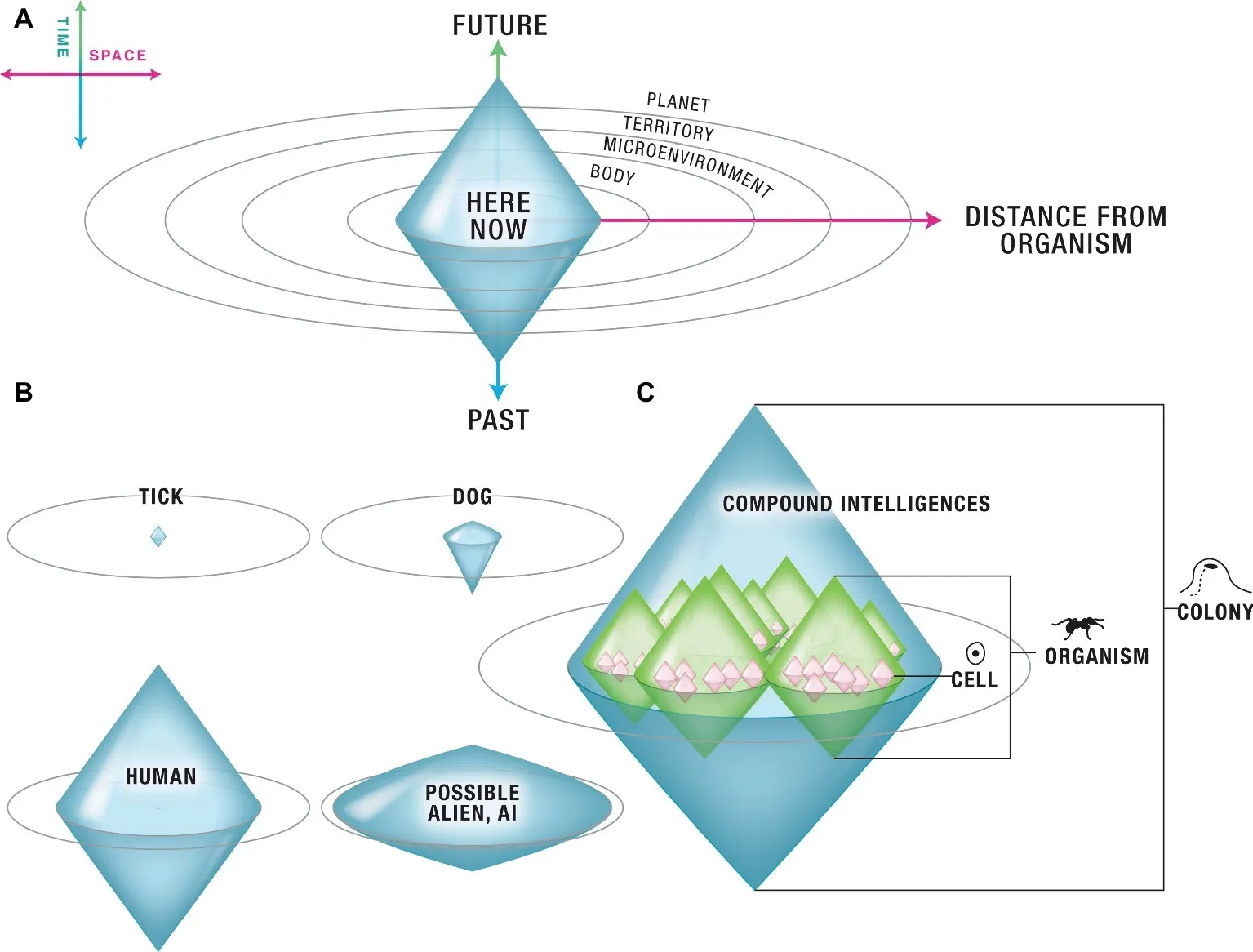
I was surprised to hear this because I know he was not strictly the first to use the concept of a "cognitive light cone" in psychology. I know this because I was taught about it in 1988-1989 by Prof Bob Shaw, a brilliant ecological psychologist at the University of Connecticut, who was a mentor to me and a colleague of my PhD advisor, Mike Turvey. Bob Shaw and his son Jeff Shaw (and colleague) first used the concept in 1988 in their paper "Ecological mechanics: A physical geometry for intentional constraints" published in Human Movement Science. I have the Apple SE30-formatted dot-matrix hard copy. Those were the days!! They adapted Minkowski's spacetime light cone to describe how an organism's intentions are recursively partitioned into a fractal, cause-and-effect geometry, into what they called Ω-cells (omega cells) — explaining how information controls local action without appeal to ungrounded mental constructs.
Levin's 2019 "cognitive light cone" similarly builds on that metaphor, applying it as a continuous scale running from cellular bioelectricity to synthetic biology and AI networks. He calls it the cognitive light cone because it is a concept based on Minkowski's light cone in physics, just as Shaw had first borrowed the metaphor from Minkowski. It is a way of describing the space-time region that can influence or be influenced by a given event. In Levin's context, the cognitive light cone refers to the range of potential influences on an organism's behaviour - what we, as ecological psychologists, would recognise as its perception-action limits.
I asked Google's AI Mode, and it "confirmed" Levin was its origin! I disagreed and told it the reference for the actual first use, which was by Robert Shaw and his son (and colleague), Jeff Shaw, in 1988. Below is the exchange.
AI gets corrected about "cognitive light cone"


Google AI replied - with citations:
Michael Levin invented the concept of the cognitive light cone. [1, 2] (AI IS WRONG!)He introduced this framework in his 2019 paper, The Computational Boundary of a "Self": Developmental Bioelectricity Drives Multicellularity and Scale-Free Cognition. [3, 4]
The Core Concept
Levin's cognitive light cone is a tool used to map out and measure the intelligence of any given system (whether it is a bacterium, a dog, a human, an AI, or an alien life form) based on its goals: [5, 6, 7]
- Definition: It represents the spatial-temporal boundary of the largest goal that a system can actively pursue, monitor, and care about. [3, 6]
- What it is not: It is not determined by how far a creature's eyes can see or how far its limbs can reach (its sensors or effectors). [1, 5]
- The Spectrum:
- A bacterium has a tiny cognitive light cone; it only pursues local, immediate goals like managing the pH or sugar levels in its direct vicinity.
- A dog has a larger cone; it can think about goals across a wider physical territory and slightly into the future (like waiting for its owner).
- A human has a massive cognitive light cone; we can dedicate our lives to massive abstract goals that span centuries or encompass the entire planet (e.g., stopping climate change, or planning missions to other stars). [5, 6, 8]
Where the Name Comes From
Levin borrowed the physical layout of a Minkowski light cone from Einstein's theory of relativity (where time is tracked on the vertical axis and space on the horizontal axis). However, instead of mapping the speed of light and causal events, Levin uses it to map the boundaries of an agent's care and agency. [3, 5, 9, 10]
True metaphors
For the record: Robert E. Shaw and Jeffrey Kinsella-Shaw laid the groundwork first - in their 1988 paper, Ecological mechanics: A physical geometry for intentional constraints, published in Human Movement Science (PDF below)
They adapted Minkowski's spacetime light cone as a metaphor to describe how an organism's intentions recursively partition cause-and-effect geometry into what they called Ω-cells explaining how field-based, ecological information controls local action without appeal to ungrounded "cognitive" internal mental representations.Perhaps Levin was unaware of this prior use from 1988 – 30 years before Levin published on it. If so he should give credit to Shaw and the endless insights generated by Gibson and the ecological approach to psychology. He already incorporates the affordance concept, so he is clearly aware of the ecological approach. Perhaps he was unaware of the Connecticut school and its work on ecological mechanics and Ω-cells.
Regardless, it is good to see that Bob Shaw's complex ideas have been vindicated. His work on morphogenisis and how the form of a head and face changes over time, was in part inspired by D'Arcy Thomson's work on morphogenesis. Interestingly, Michael Levin also draws on D'Arcy Thomson's concepts as can be seen in his lectures, and also discusses key dynamical systems concepts such as attractors and stability. Bob Shaw was a thinker of great depth, breadth, complexity, and vision - as we all realised at the time while taking graduate courses with him, or receiving suggestions during our PhD research, and being lucky to have enjoyed him in Mike Turvey's basement pub on a Friday night, when he would share his insights and ideas with anyone, over a creamy dark pint of Pure Genius.

Watch this snip where Levin explains his use of metaphors and the metaphor of "light cone" (more
videos
in references):
Video: Levin on cognitive light cones
Google AI's citations
- https://www.youtube.com/shorts/rAsIQGXdVRM
- https://www.researchgate.net/publication/345815728_How_Do_Living_Systems_Create_Meaning
- https://www.frontiersin.org/journals/psychology/articles/10.3389/fpsyg.2019.02688/full
- https://pubmed.ncbi.nlm.nih.gov/31920779/
- https://www.youtube.com/watch?v=YnObwxJZpZc&t=51
- https://www.youtube.com/watch?v=-dtdZ00Dh6g&t=113
- https://medium.com/design-bootcamp/michael-levins-key-lessons-for-the-21st-century-designers-3bcfcc7b2f7d
- https://www.youtube.com/shorts/sFXi7j4hlp8?vl=en
- https://pmc.ncbi.nlm.nih.gov/articles/PMC9140411/
- https://www.organism.earth/library/topic/cognitive-light-cone
- https://maceecopsy.site/robert-shaw/
- https://medkharbach.com/cognitive-surrender-how-ai-is-quietly-reshaping-the-way-we-think/
- https://lifespan.io/michael-levin-on-bioelectricity-in-development-and-aging/
- https://theconsciousness.ai/researchers/michael-levin/
References
ORIGINAL SHAW ARTICLE:
Shaw, R. E., & Kinsella-Shaw, J. (1988). Ecological mechanics: A physical geometry for
intentional constraints. Human Movement Science, 7, 155-200.
Primary sources
- Gibson, J. J. (1979). The Ecological Approach to Visual Perception. Psychology Press.
- Levin, M. (2019). The Computational Boundary of a "Self": Developmental Bioelectricity Drives Multicellularity and Scale-Free Cognition. Frontiers in Psychology. (Also on PubMed.)
- Shaw, R. E., & Kinsella-Shaw, J. (1988). Ecological mechanics: A physical geometry for intentional constraints. Human Movement Science. — the original paper adapting the Minkowski light cone to psychology.
Videos
- Michael Levin on cognitive light cones (interview)
- Levin explaining the cognitive light cone
- Levin on cognitive light cones (extended)
- Levin — cognitive light cone (short)
- Levin — human cognitive light cones (short)
Further reading
- organism.earth — Cognitive Light Cone (topic library)
- Biology, Buddhism, and AI: Care as the Driver of Intelligence — related article on light cones and scale-free cognition
- Medium — Michael Levin's Key Lessons for 21st-Century Designers
- ResearchGate — How Do Living Systems Create Meaning?
- lifespan.io — Michael Levin on bioelectricity in development and aging
- theconsciousness.ai — Michael Levin researcher profile
- medkharbach.com — Cognitive surrender: how AI is quietly reshaping the way we think
- Wikipedia — Minkowski spacetime
On Robert Shaw and the Connecticut school
- Robert E. Shaw — biographical page
- Robert E. Shaw — University of Connecticut profile
- Robert E. Shaw — Interview and Reflection (ResearchGate)
- Robert E. Shaw — Interview and Reflection (Academia.edu)
- Intentional Dynamics of Situated Action (Academia.edu)
- APA PsycNet record
- Jeffrey Kinsella-Shaw — University of Connecticut profile
- Jeffrey Kinsella-Shaw — Academia.edu profile
- Swenson, R., & Turvey, M. T. (1991). Thermodynamic reasons for perception-action cycles. Ecological Psychology, 3(4), 317–348. Swenson & Turvey.
- Swenson, R. (2023). A grand unified theory for the unification of physics, life, information, and cognition (mind). Phil. Trans. R. Soc. A 381: 20220277.
- University of Connecticut: Centre for the Ecological Study of Perception and Action (CESPA)
- International Society for Ecological Psychology (ISEP)
PDF version
Treffner, P. J. (2026). Life, AI, and Self-organisation: Michael Levin
Related ideas

Paul Treffner
metaffordance.com