How real is Sophia's dream?
Gibson refused a soul inside perception, and he was right to. That refusal does not settle how the world is capable of being perceived at all, and the gap it leaves open is wide enough to keep a literal Gnostic reading on the table, not merely a useful story.
The question asked plainly
Sophianic metaffordance was careful, maybe too careful, about a question it kept raising and then setting down: is Sophia's dreaming meant literally, or is it a way of talking. The honest answer is that the piece is built to survive either reading, which is not the same as taking a position. It is worth taking one.
Five ways to read a dreaming Sophia
"Sophia dreams the world" can mean at least five different things, and they are not shades of the same claim, they are different claims with different truth conditions.
The weakest reading treats it as pure redescription. Reality keeps generating new structure from old, and "dreaming" is just a vivid word for that, the way a physicist says a system "wants" to minimize energy without meaning to attribute desire. Nothing is added to the facts by saying it this way, only a mood. Call this a narrative metaffordance. It is a legitimate thing for an idea to be. It is also, on its own, an evasion of the question actually being asked.
One step up is structural realism without any experience in it anywhere: reality really is fundamentally generative and self-differentiating, something like a process metaphysics, but there is no psyche in the picture at any scale, weak or strong. "Dreaming" is still a metaphor here, a more committed one, since it asserts a real thesis about becoming rather than being, but a metaphor nonetheless.
Third is ecological panpsychism, the position the Sophianic piece reaches for explicitly: experience is real and distributed wherever there is an organism-environment relation, a bacterium has some form of experience proper to its own organisation, but there is no single subject doing any of the dreaming. "Sophia" names an aggregate on this reading, not an experiencer, the way "the market" isn't a subject even though real decisions are happening everywhere inside it.
Fourth is the strong claim: literal priority cosmopsychism or analytic idealism, where there is one fundamental psyche and the physical universe is what its dreaming looks like from inside, organisms are perspectives within a single subject rather than an aggregate of separate ones. This is a defended position in contemporary philosophy of mind, not mysticism wearing a lab coat, and it is the claim Gibson's unasked question actually commits to: "psyche came first," stated as "a real escalation, not a restatement" of the weaker position taken in Metaffordance and the mind-matter problem, which had left mind and matter as co-equal aspects of a deeper process without saying which came first. Bernardo Kastrup is well-known for his analytic idealism. Michael Levin is similarly aligned, and I wrote about Levin's perspective here: Life, AI, and Self-organisation.
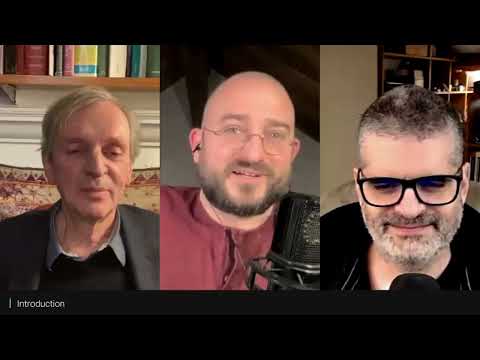
Kastrup can be seen discussing this position with Rupert Sheldrake, whom I have mentioned before, in this interview.
Fifth is full mythological realism, Sophia as an actual Aeon within a real Pleroma, the ancient cosmology taken as revealed rather than philosophical. This piece does not need that step to make its argument, but it does not rule it out either, and ruling it out just because it is the oldest and least fashionable option would be its own kind of intellectual cowardice.
You can explore mythological realism through videos on my YouTube channel, PerceivingActing. See the playlist "Gnosis".
The interest in and scholarly study of Gnostic ideas and Sophia has increased dramatically since the discovery of the Nag Hammadi texts in Egypt in 1945. These are the oldest leather-bound books in existence, written in 350-400 CE in Coptic by Christian heretics. They show that early Christian thought was far more diverse before orthodox doctrines were established. They include explicit mention of Sophia, the Archons, and the head Archon, the Demiurge, who the Gnostics claimed is a false, imposter god, subservient to higher entities, the Aeons at the Galactic core, the Pleroma, from where Sophia "fell" to Earth and "became" the Earth, Gaia. Following this ancient mythology, mythological realism implies our experience is the actual dreaming of Gaia-Sophia.
Sophianic Animism: a contemporary articulation
Mythological realism is not only an ancient option. John Lash (2021/2006) names and defends a present-day version of it, Sophianic Animism, which holds Sophia to be a literal Aeon and the living Earth to be her ongoing dreaming, known not through faith but through direct experiential Gnosis:
"Animism" denotes the action of life not merely as a vital force, but more fully and deeply, animating force. "Sophia" denotes what upholds and directs that animation. Pervading the spectrum of all that lives is a super force that imparts direction and diversity of expression. SA is recognition of that supernatural force and bonding with it. If the animating matrix of life is intelligent, willful, and responsive to what it produces, it is appropriate to name it and treat it as a living creature having those attributes. The planetary animal called "Mother Earth" is the central figure in SA, rather than an off-planet father god or any other type of creator (authoritative, punitive) in Abrahamic religions. The mother goddess is a grounded presence accessible to the human mind and senses. The aim of SA is to interact with that presence, not through faith or fantasy, but experimentally, via a path of learning called Gnosis. SA draws its founding elements from the Gnostic movement of antiquity, the most repressed, persecuted and vilified body of knowledge in human history. Like Gnosis, SA is a heresy: "that which is chosen" (from Greek 'hairein', to choose). As a heresy, it stands against all other religions. Gnosis is an alternative to religion, an option to forgo religious beliefs of all kinds, cultures, and periods. It is direct knowing of the natural and supernatural dimensions of existence, including the self-reflecting intellect and psyche in its sensuous, emotional, imaginal aspects. SA asserts that the soul-life of human creatures unfolds as an event in the natural world, produced by the same forces that cause the seasons, the tides, the growth and decay of natural forms. Although it draws upon Gnosis and shares many of its features, SA stands alone as a unique exercise of faith that can be verified, supported by evidence and confirmed through shared experience. The basic faith of every human creature is: the power of life that puts you here keeps you alive. As long as you desire to live, you naturally hold faith in the transcendent life force that produced you. SA takes the name of the natural and supernatural matrix of life on earth from Gnosis: Sophia, the Greek word for wisdom. She is the planetary animal mother (PAM). The narrative of the Mysteries derived from primordial Gnosis describes her status by three Ss: Source, Story, Setting. As the Aeon Sophia, a divine power from the galactic centre, She is the source of life, the intelligent deity that designed the human species, the Anthropos. Her story, the Fallen Goddess Scenario (FGS), is the myth that guides the races of the anthropine species. Finally, Sophia is materially present in the setting of life, the natural world, comparable for her to the body you experience when acting in a dream. The world drama on earth is the product of Sophia's Dreaming. In summary, Sophianic Animism is immersion in the wisdom of life by choosing to bond with its divine source. It is a call to existentially engage the Sacred. So, there you have it, something you never thought you'd live to see the day of. By the way, in the last sentence, I changed the word calling to 'call'. It is both a call and a calling. And I will, goddess willing... It is a sacred calling. Sophianic Animism is not a religion. It's not another religion; it is not an alternative religion. It's a sacred calling to every individual person who is capable of comprehending that such a calling can exist.
John Lash, "What is Sophianic Animism?", Gnosis playlist. See also sophianicmyth.org.
Where Gibson's refusal actually cuts
Gibson is on record refusing a soul three times, in three different arguments, and I agree with him without reservation in every one of them. The clearest statement is the one worth repeating here:
"The ambient stimulus information available in the sea of energy around us is quite different. The information for perception is not transmitted, does not consist of signals, and does not entail a sender and a receiver. The environment does not communicate with the observers who inhabit it. Why should the world speak to us? The concept of stimuli as signals to be interpreted implies some such nonsense as a world-soul trying to get through to us."
James J. Gibson, The Ecological Approach to Visual Perception (1979)
Nothing in the strong reading defended here asks for that sender back. Gibson's refusal operates entirely inside the specification relation, at the moment of perceiving, where positing an interpreter, a coder, a homunculus at the switchboard, buys nothing and explains nothing. Gibson's unasked question makes the full case for why his three refusals hold. A generative ground for Sophia to name is not proposed as a sender inside that relation. It is proposed as whatever it is that makes a lawfully structured, information-specifying world available to be perceived in the first place, a question Gibson took as already settled by the time his method began, not one he investigated and closed off. His silence about it is not evidence against it.
Why the weak reading does not pay its own debt
The reason to resist stopping at a narrative metaffordance is that it leaves a genuine explanatory debt unpaid. Something makes it the case that there is a lawfully structured world capable of specifying anything to anyone, rather than undifferentiated noise with no looks to have, and rather than nothing at all. Calling this "dreaming" as pure metaphor describes the fact without touching the debt. It does not answer the question a strong reading is actually trying to answer, which is not "how should we talk about generativity" but "why is there anything generative to talk about."
A model earns more than metaphor status when it does explanatory work a thinner account cannot. A generative, proto-experiential ground is doing just that kind of work if it is the only available answer to why there is experience at all instead of none, and why the world that experience discloses turns out to be lawful rather than arbitrary. That does not make the strong reading proven. It makes it a live hypothesis competing on the same terms as its rivals, not a poetic ornament sitting outside the competition.
Not agnosticism either
There is a difference between refusing to answer and refusing to answer prematurely. Agnosticism says the question cannot be settled, so no position should be held. What is being held here is narrower and more committed than that: the strong reading, positions four and five above, has not been ruled out by anything Gibson or ecological psychology actually establishes, and it is doing real explanatory work that the weak readings do not do. That is a reason to keep it in play as a live candidate, stated as such, not a shrug dressed up as intellectual humility.
Consciousness, considered three times
Metaffordance, Consciousness, and Morphic Resonance treats consciousness as the lived awareness of a structured field of affordances and metaffordances, without yet asking whether that field is grounded in one psyche or many. Metaffordance and the mind-matter problem takes the next step, treating mind and matter as co-equal aspects of a single generative process. Gibson's unasked question takes the step after that, naming the generative process itself as psyche-first. This piece is the one that says plainly that the last step is not a story being told for its explanatory convenience. It is a candidate for what is actually the case.
What is actually being claimed
Sophia's dream, on the reading defended here, is not required to be a finished universe authored moment to moment by an intending mind, and it is not required to populate the world with discrete supernatural furniture, Aeons and a Pleroma taken as literally as a map of the solar system. What it is required to be is a real answer to a real question: that the generative, world-disclosing ground of things is itself something more like a psyche than like inert structure, and that organisms, including us, are modes within it rather than spectators of it from outside. That is a metaphysical claim, not a manner of speaking, and it stays on the table because nothing so far has taken it off it.
References
Gibson, J. J. (1979). The Ecological Approach to Visual Perception. Psychology Press.
Lash, J. L. (2021). Not in his image: Gnostic vision, sacred ecology, and the future of belief (15th anniversary ed.). Chelsea Green. (Original work published 2006)
Related ideas

Paul Treffner
metaffordance.com