America's highest science honour: Eleanor Gibson and Trump's uncle, before the AI founders
The National Medal of Science is America's highest science honour and is often compared to the Nobel Prize. On 8 October 2026 the President presented the National Medals of Science and of Technology and Innovation to six leaders of the computing industry. Thirty-four years earlier the same science medal went to Eleanor J. Gibson, for working out how a living learner comes to see what the world offers or affords. And before either, it went to the President's uncle.
The 1992 laureate
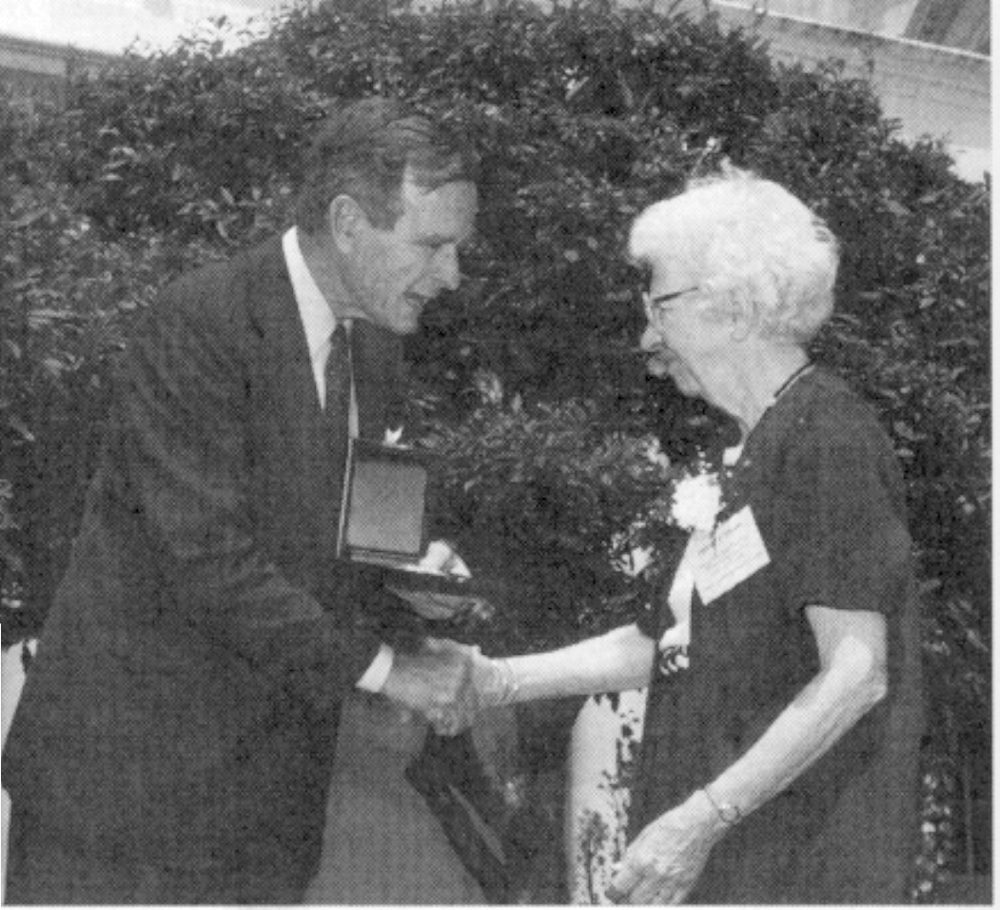
In 1992 the National Medal of Science in Behavioral and Social Science went to Eleanor J. Gibson of Cornell University. She was 82. The citation reads "for her conceptual insights in developing a theory of perceptual learning; and for achieving a deeper understanding of perceptual development in children and basic processes in reading" (National Science and Technology Medals Foundation, n.d.).
Most people know her through the visual cliff. She and Richard Walk put crawling infants on a glass sheet that ran over a shallow side and a deep drop. Of the 27 babies who left the centre board, only three crept onto the deep side, even with their mothers calling them (Gibson & Walk, 1960). A crawling baby sees the drop as a place to fall. It perceives an affordance before it has a word for one.
My lecture shows the visual cliff in action, from 49:41.
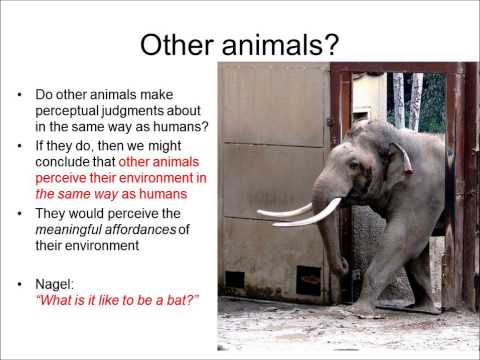
Her deeper contribution was a theory of how that perceiving gets better. In 1955 she and James J. Gibson asked whether perceptual learning is differentiation or enrichment (Gibson & Gibson, 1955). The enrichment view says the learner adds memories and associations to thin sensations. The Gibsons argued the reverse. The information is already rich. The learner learns to pick out more of it, finer distinctions, invariants that hold across change, and the features that matter for what it is trying to do. Her 1969 book set this out as a full theory (Gibson, 1969). Her own line sums it up: "We perceive to learn, as well as learn to perceive."
James never received the medal. His three books built the ecological approach and gave us the word "affordance" (Gibson, 1950; 1966; 1979). Eleanor's medal is the nation's recognition of the joint programme. Her late book on the two of them is called Perceiving the Affordances (Gibson, 2002).
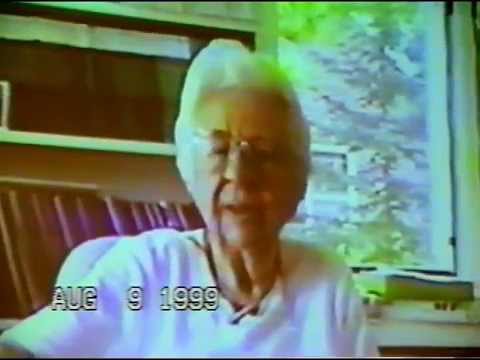
Watch Eleanor Gibson speak on development and affordances at the International Conference on Perception and Action (ICPA) in Edinburgh on 9 August 1999. She is 88 years old here.
The other Trump and the medal
John G. Trump (1907-1985) was the President's uncle and an MIT electrical engineer. He did his doctorate with Robert Van de Graaff and spent his career on high-voltage machines (Thomas, 2016).
- Cancer radiotherapy. In 1935 he showed that an electron beam striking a gold target gave strong X-rays. In 1937 a one-million-volt X-ray generator he built with Van de Graaff began treating cancer patients at Huntington Memorial Hospital in Boston. He later pioneered rotational radiation therapy, in which the beam circles the patient. That idea is still in use. In a 1978 filmed interview he recalls this early radiation work himself (From the Vault of MIT, 2016).
- Industrial X-rays. In 1939 he and Carlton Lutts used the generator to X-ray thick steel in 100 seconds. Radium took about 65 hours.
- Radar in the Second World War. He helped set up the MIT Radiation Laboratory in 1940. In February 1944 he went to England to lead its British Branch, and stayed through D-Day and the Normandy campaign. His lab set up the MEW radar at Start Point in Devon, which gave a full picture of air operations during the invasion. It also developed radar control for close air support. A sister US lab in Britain, ABL-15, did the jamming and deception of German radar (British Branch of the Radiation Laboratory, n.d.).
- Tesla's papers. When Nikola Tesla died in 1943, the government asked him to examine Tesla's papers. He reported that they held nothing of military value. At the 2026 ceremony, his nephew Donald said his uncle had also wanted to know whether Tesla was "for real and not a fake" (Forbes Breaking News, 2026; watch the video).
- Industry and the environment. In 1946 he co-founded High Voltage Engineering Corporation with Van de Graaff and Denis Robinson. It built compact cancer-therapy machines and research accelerators. In his last decade he used electron beams to disinfect sewage sludge and wastewater.
- Honours. King George VI gave him the King's Medal for Service in the Cause of Freedom in 1947 for his radar work. Truman gave him the President's Certificate of Merit in 1948. President Reagan awarded him the National Medal of Science for 1983, for "beneficial application of ionizing radiation to medicine, industry and atomic physics." John Trump died in February 1985, six days before the ceremony, so his son accepted it on his behalf (John G. Trump, n.d.).
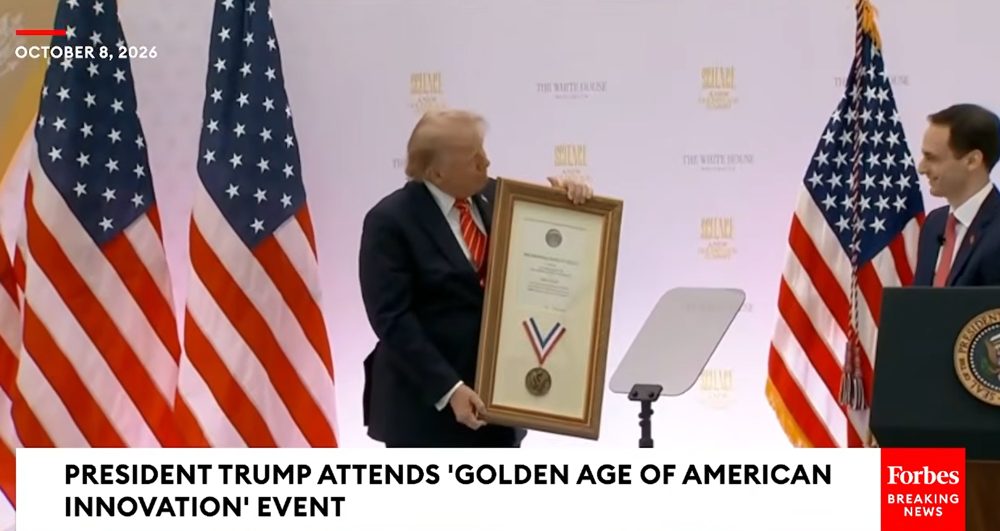
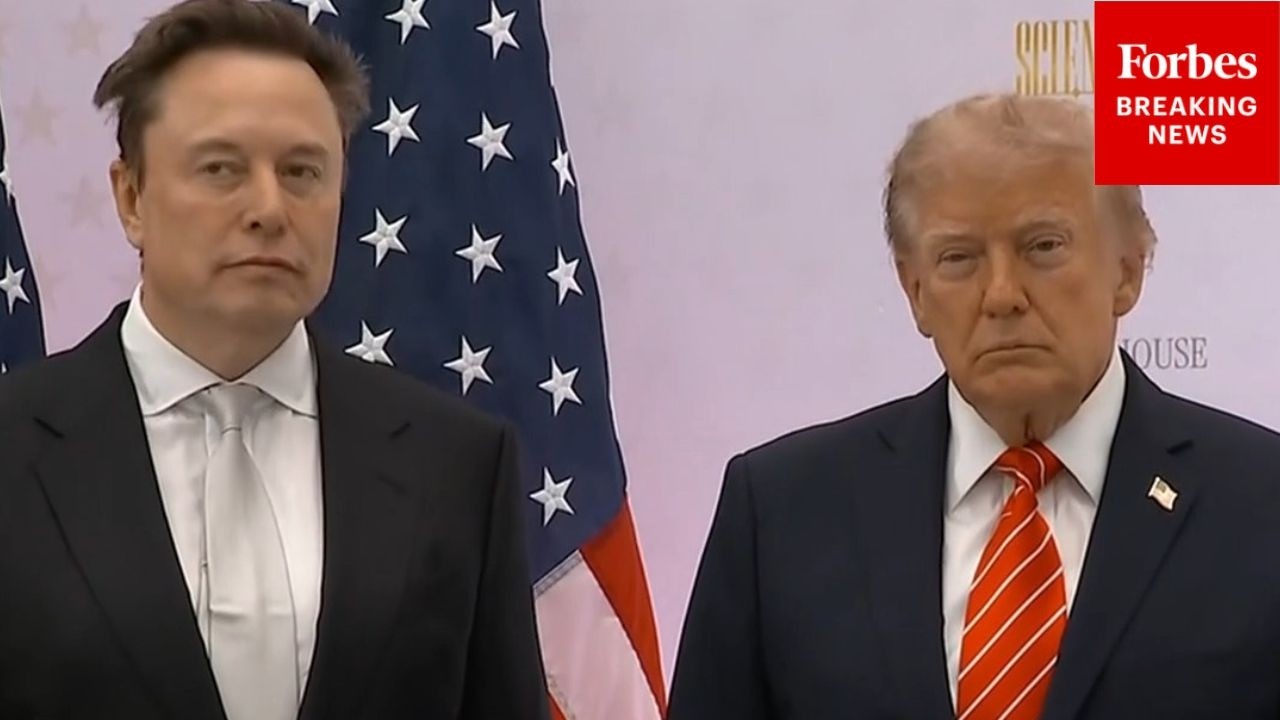
His business partner called him "the mildest of men." At the 2026 ceremony the President received his uncle's own National Medal of Science. The medal had been found and was handed to him on stage, framed with its citation (Forbes Breaking News, 2026; Vive USA, 2026).
Today's laureates
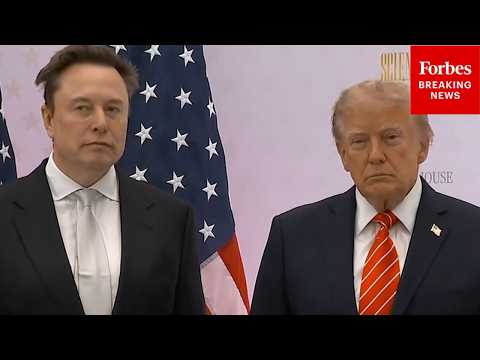
The White House release of 8 October 2026 names four recipients of the National Medal of Science and two recipients of the National Medal of Technology and Innovation (White House, 2026).
Watch the ceremony in the Forbes Breaking News video (Forbes Breaking News, 2026).
National Medal of Science
- Elon Musk, for "engineering achievements of extraordinary ambition and scale."
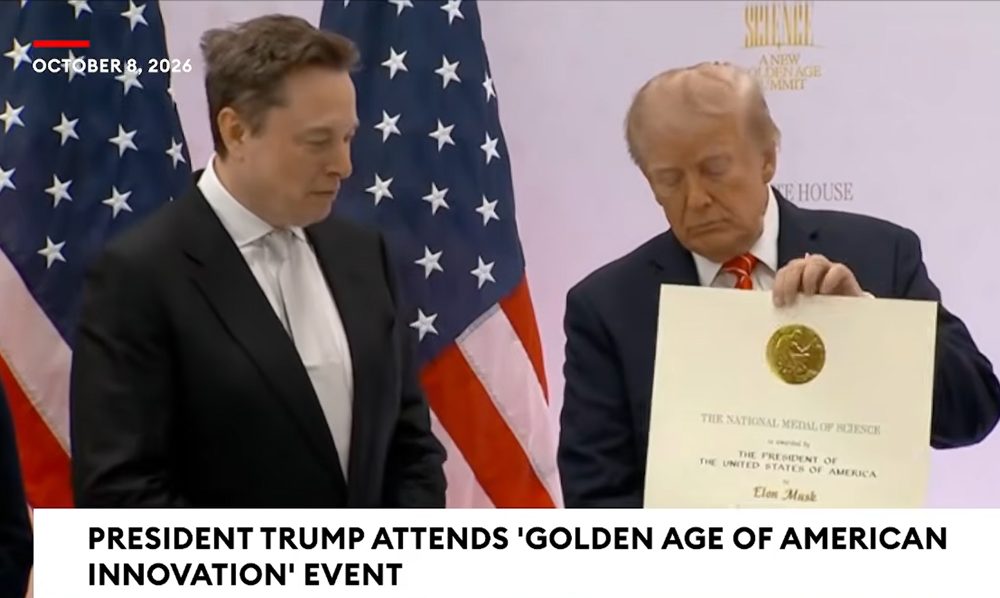
Elon Musk with President Trump. Image: Forbes Breaking News, 8 October 2026. - Sergey Brin, for "the development of foundational algorithms for information retrieval
and data processing."
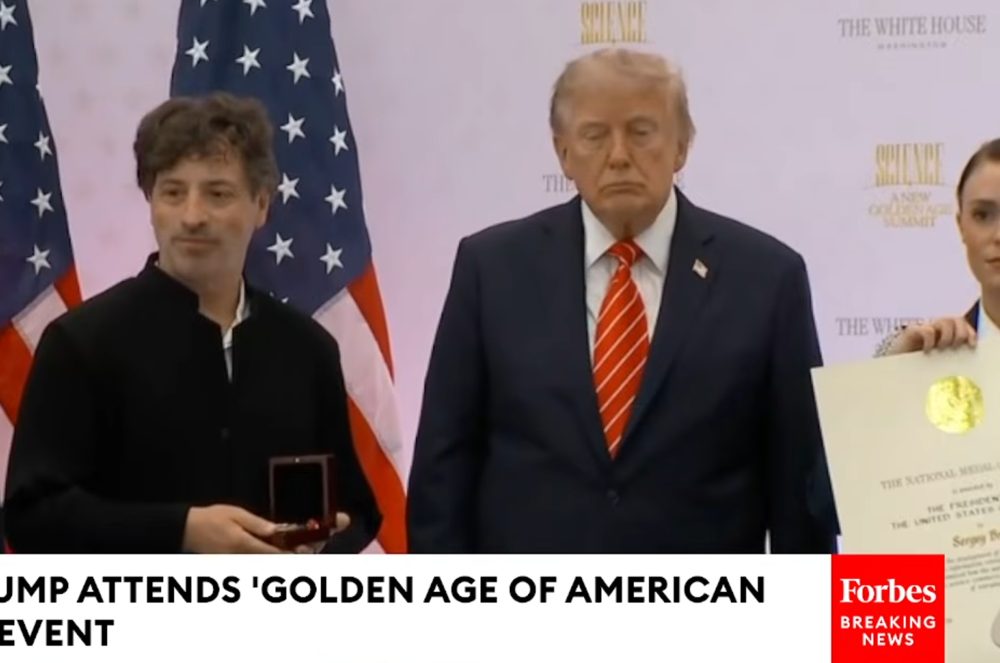
Sergey Brin with President Trump. Image: Forbes Breaking News, 8 October 2026. - Jensen Huang, for "advancing the graphics processing unit into a general-purpose
computing architecture."
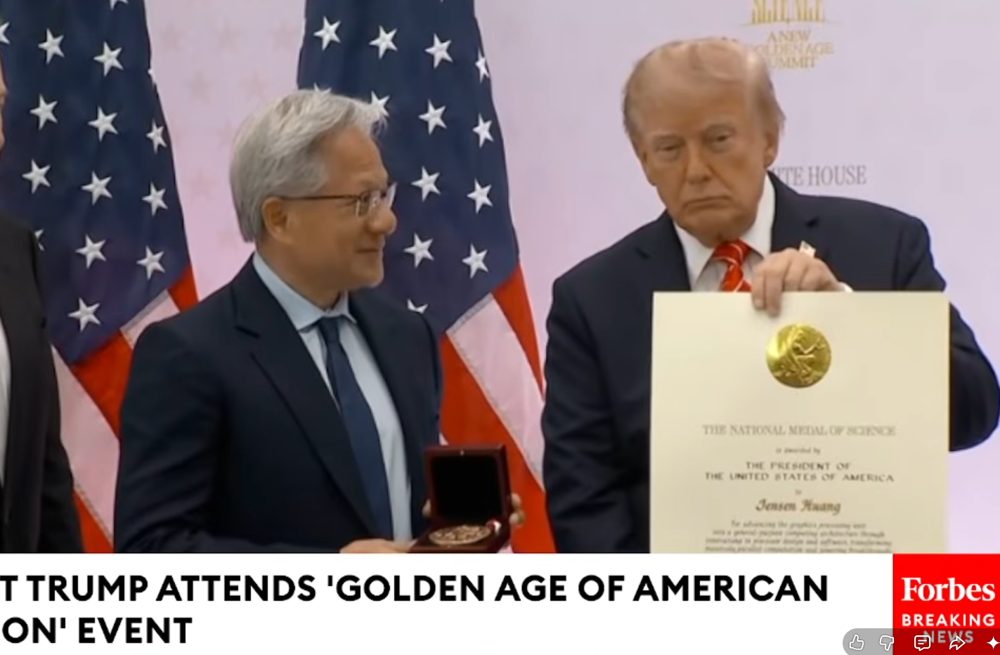
Jensen Huang with President Trump. Image: Forbes Breaking News, 8 October 2026. - Lisa Su, for "a lifetime of leadership in semiconductor engineering and
high-performance computing."
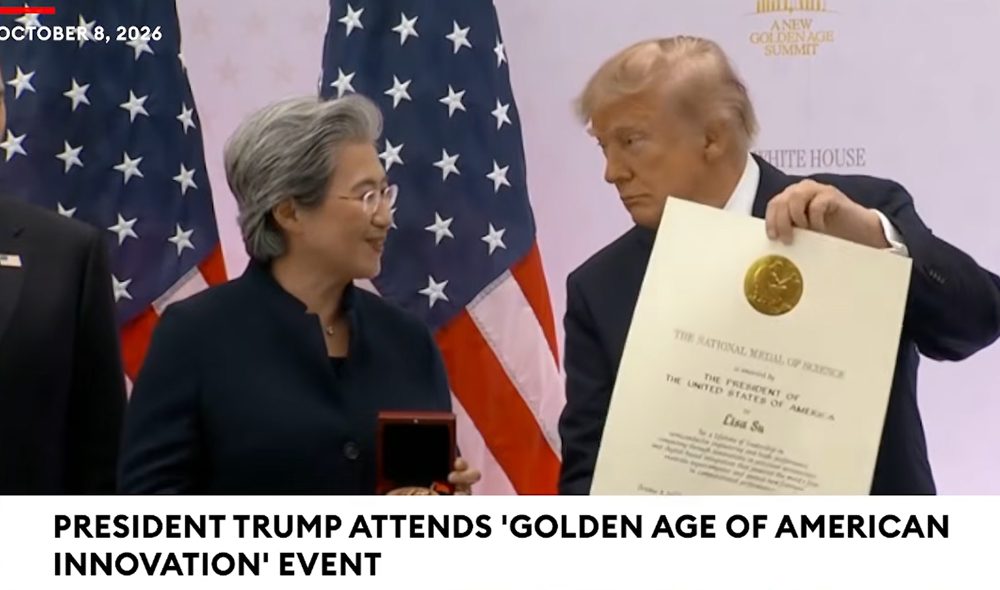
Lisa Su with President Trump. Image: Forbes Breaking News, 8 October 2026.
National Medal of Technology and Innovation
- Michael Dell, for "advancing a vision of widespread adoption of personal and enterprise
computing."
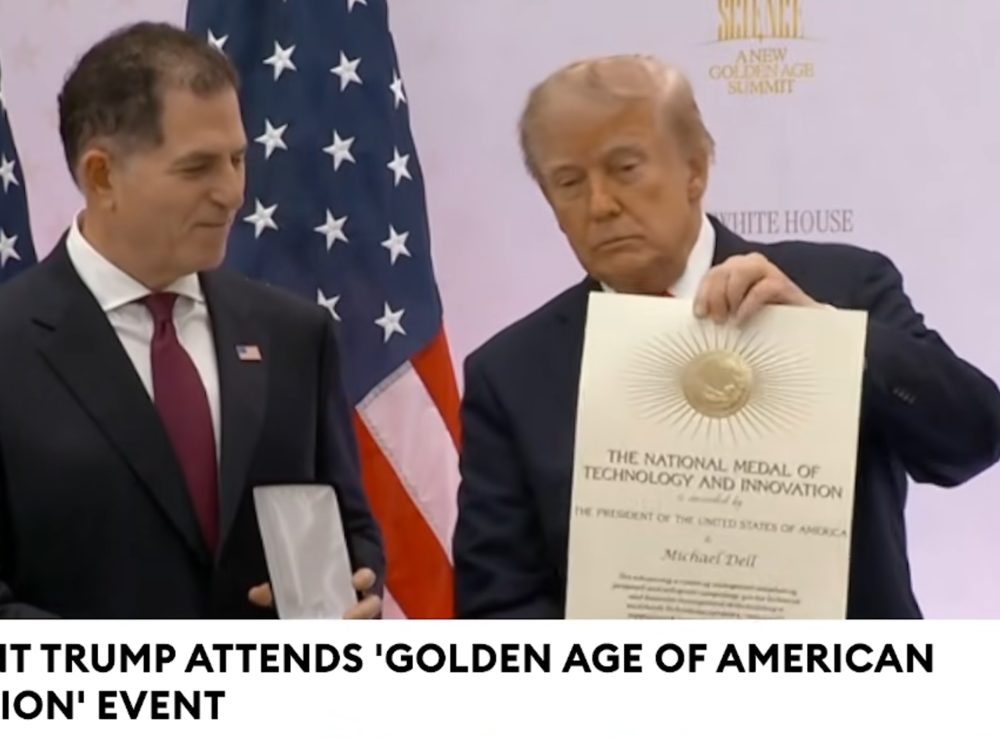
Michael Dell with President Trump. Image: Forbes Breaking News, 8 October 2026. - Satya Nadella, for "his transformative leadership of a critical American technology
company."
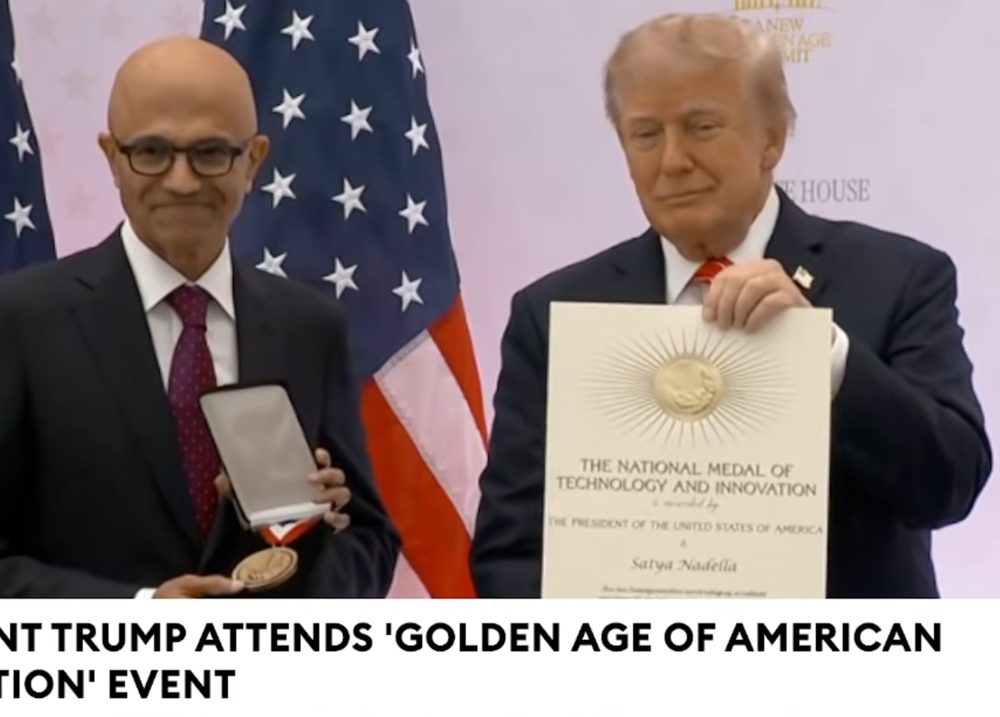
Satya Nadella with President Trump. Image: Forbes Breaking News, 8 October 2026.
These are the people who built the machinery of modern AI. Musk founded xAI and co-founded OpenAI. Brin co-founded Google. Huang co-founded Nvidia, whose chips train most large models. Su leads AMD. Dell builds the servers, and Nadella's Microsoft is OpenAI's largest backer. The release itself talks about "super intelligence." The medals honour search, silicon, scale and the businesses that deliver them.
Two kinds of learning
Large AI models learn by enrichment. They take in vast amounts of text and images and build up statistical associations, layer on layer, with billions of parameters and the chips Huang and Su make. That works far better than most psychologists expected. It also costs vast amounts of energy and data.
A child on the visual cliff does something else. She has a few months of crawling and no training set to speak of. She still reads the drop as a drop, because the optic array specifies it and her actions have tuned her to that information. Gibson's theory says this is the normal case. Learning narrows and sharpens attention to what is already there. It does not pile up associations on top of poor input.
This is where the two medals meet. Builders of agentic AI now talk about systems that act in the world, use tools and pick out what matters in a scene. Those are affordance problems. A robot needs to see that a cup can be grasped and a ledge can be fallen from. An agent needs to notice what its tools let it do. Gibson's work is the science of how organisms solve that problem cheaply and reliably. Metaffordances extend it to how an agent perceives the possibilities that other agents and systems create for it (see Agentic AI: metaffordances on steroids). Scott Kelso and I link this to metastable coordination dynamics. A learner stays poised between several ways of acting and settles on one as the situation demands (Treffner & Kelso, 2026).
What the comparison shows
The 2026 medals reward engineering at enormous scale, and the achievements are real. The 1992 medal rewarded an idea about learning that the engineering has still not fully absorbed. A system that learned by differentiation would need less data and would carry its knowledge in its tuning to the world. It would perceive affordances the way the infant does.
Before the AI founders, the United States gave its highest science award to a psychologist who spent fifty years watching children and animals learn to see. Her answer to how a mind meets the world is still worth reading, especially by the people building artificial ones.
References
Medals
Forbes Breaking News. (2026, October 8). Trump awards Elon Musk, Jensen Huang, Sergei Brin, & others National Medal of Science [Video]. YouTube. https://www.youtube.com/watch?v=k1HRPESsyoM
National Science and Technology Medals Foundation. (n.d.). Eleanor J. Gibson. https://nationalmedals.org/laureate/eleanor-j-gibson/
Vive USA. (2026, October 8). Trump entrega a Elon Musk la máxima distinción científica de Estados Unidos y lo llama "tesoro nacional" [Trump gives Elon Musk the highest US scientific honour and calls him a "national treasure"]. https://www.viveusa.mx/en/noticias/trump-entrega-a-elon-musk-la-maxima-distincion-cientifica-de-estados-unidos-y-lo-llama-tesoro-nacional/
The White House. (2026, October 8). President Trump presents National Medals of Science and National Medals of Technology and Innovation. https://www.whitehouse.gov/releases/2026/10/president-trump-presents-national-medals-of-science-and-national-medals-of-technology-and-innovation/
John G. Trump
British Branch of the Radiation Laboratory. (n.d.). In Wikipedia. Retrieved October 10, 2026, from https://en.wikipedia.org/wiki/British_Branch_of_the_Radiation_Laboratory
From the Vault of MIT. (2016, January 20). Vignettes of early radiation workers (1978) [Video]. YouTube. https://www.youtube.com/watch?v=wozw24RACZ8
John G. Trump. (n.d.). In Wikipedia. Retrieved October 10, 2026, from https://en.wikipedia.org/wiki/John_G._Trump
Thomas, W. (2016, September 7). A profile of John Trump, Donald's accomplished scientist uncle. Physics Today. https://physicstoday.aip.org/news/a-profile-of-john-trump-donalds-accomplished-scientist-uncle
Treffner and Kelso
Treffner, P., & Kelso, J. A. S. (2026; in progress). Beyond stability: Metastability and metaffordance. metaffordance.com.
Eleanor J. Gibson
Eleanor J. Gibson. (n.d.). In Wikipedia. Retrieved October 10, 2026, from https://en.wikipedia.org/wiki/Eleanor_J._Gibson
Gibson, E. J. (1969). Principles of perceptual learning and development. Appleton-Century-Crofts.
Gibson, E. J. (1991). An odyssey in learning and perception. MIT Press. Free to borrow from the Internet Archive with a free account.
Gibson, E. J. (2002). Perceiving the affordances: A portrait of two psychologists. Lawrence Erlbaum.
Gibson, E. J., & Levin, H. (1975). The psychology of reading. MIT Press.
Gibson, E. J., & Pick, A. D. (2000). An ecological approach to perceptual learning and development. Oxford University Press.
Gibson, E. J., & Walk, R. D. (1960). The "visual cliff." Scientific American, 202(4), 64–71. https://doi.org/10.1038/scientificamerican0460-64
Gibson, J. J., & Gibson, E. J. (1955). Perceptual learning: Differentiation or enrichment? Psychological Review, 62(1), 32–41. https://doi.org/10.1037/h0048826
James J. Gibson
Gibson, J. J. (1950). The perception of the visual world. Houghton Mifflin. Free to borrow from the Internet Archive with a free account.
Gibson, J. J. (1966). The senses considered as perceptual systems. Houghton Mifflin. Free to borrow from the Internet Archive with a free account.
Gibson, J. J. (1979). The ecological approach to visual perception. Houghton Mifflin. (Classic edition published 2015 by Psychology Press)
Related ideas

Paul Treffner
metaffordance.com