Metaffordance and Olfaction/Taste
An ecological psychology approach to olfaction and taste using metaffordance concepts differs substantially from traditional approaches that treat smell and taste as internal sensory representations of chemical stimuli.
The central question becomes:
What information about affordances is specified by smell and taste, and how does that information guide action?
Traditional View
The standard cognitive account is:
Chemical molecules → receptors → neural representation → perception → decision → action
Taste and smell are treated primarily as sensory experiences occurring inside the brain.
Ecological View
An ecological approach asks:
What opportunities and dangers in the environment are directly detectable through chemical information?
Examples include:
- Ripe fruit affords eating.
- Rotten meat affords avoidance.
- Smoke affords escape or investigation.
- Human body odour affords social interaction.
- Fresh water affords drinking.
- Fermentation affords caution or consumption, depending on context.
The smell itself is not the primary object of perception. The affordance is.
Metaffordance Extension
The metaffordance framework suggests that affordances are not isolated opportunities for action but parts of larger systems of possibilities.
From this perspective, smell and taste become:
Information about changing affordance landscapes.
Example: The Smell of Smoke
Traditional view:
- Perceive smoke smell.
Ecological view:
- Detect a combustion event.
Metaffordance view:
- Detect transformation of the entire affordance field.
The environment is changing from:
- inhabitable
- safe
- breathable
toward:
- dangerous
- obstructed
- requiring evacuation
The smell is information about an emerging reconfiguration of affordances.
Taste as Affordance Sampling
Taste is unusual because it requires direct contact with the substance being evaluated.
From a metaffordance perspective, tasting is not primarily perception but:
Active probing of affordances.
The organism samples a small amount of material to determine whether it is:
- edible
- nutritious
- toxic
- spoiled
- medicinal
Taste functions as a local test of larger affordance possibilities.
A bitter taste often indicates:
Do not proceed with the larger affordance.
A sweet taste often indicates:
The eating affordance remains open.
Nested Affordances
Consider a cup of coffee.
The smell affords:
- approach
- drinking preparation
- social interaction
- wakefulness expectations
The taste then confirms or modifies those affordances.
The sequence becomes:
- Smell → possible affordances
- Taste → validation of affordances
- Consumption → realization of affordances
The organism continuously updates its metaffordance structure.
Temporal Affordances
Chemical information is particularly effective at revealing events distant in both space and time.
Vision often tells us:
What is here now.
Smell often tells us:
What happened recently.
Examples include:
- rain approaching
- a predator passing through
- food becoming spoiled
- a fire beginning elsewhere
Olfaction may therefore be especially important for perceiving future affordances.
The smell of leaking gas specifies a future danger before visual evidence appears.
Social Metaffordances
Human odours can specify:
- illness
- stress
- emotional state
- kinship
- reproductive status
The organism perceives not merely a smell but a changing social affordance structure.
For example, sickness odour may reduce:
- approach affordances
- food-sharing affordances
- intimacy affordances
while increasing:
- avoidance affordances
A Metaffordance Formulation
Olfaction and taste are systems for detecting chemically specified changes in affordance structure. Smell provides information about distal and emerging affordances, while taste provides information about immediately realizable affordances through direct sampling. Together they enable organisms to navigate dynamic affordance landscapes across multiple temporal and spatial scales.
This formulation places olfaction and taste alongside vision, audition, and touch as information systems for perceiving not objects or sensations, but the evolving structure of possibilities for action.
Within the broader metaffordance framework, organisms are not simply detecting individual affordances but are continuously tracking higher-order patterns of affordance creation, transformation, and loss.
TDS and an Ecological Approach to Taste Perception
Temporal Dominance of Sensations (TDS) can be reconceptualised within an ecological and metaffordance framework by shifting the focus from internal sensory representations to the information specifying changing affordances during eating. Rather than treating taste as a sequence of subjective flavour experiences, TDS becomes a method for tracking how the affordance landscape of a food evolves over time as the organism actively samples it.
From Sensations to Affordances
Traditional sensory science interprets TDS curves as the temporal unfolding of dominant internal sensations. An ecological approach reframes these "dominant sensations" as dominant sources of affordance-specifying information. For example:
- A rise in bitterness specifies a potential hazard and may close the "continue eating" affordance.
- Increasing sweetness specifies energy availability, maintaining the eating affordance.
- Astringency specifies mouth-action constraints, altering how the organism prepares to chew or swallow.
In this view, TDS does not chart internal states but the moment-to-moment control of action guided by chemical information.
Taste as Active Affordance Sampling
Taste is inherently an active, contact-based probe of the environment. Within a metaffordance framework, tasting is not simply perceiving flavour but testing the viability of larger affordances such as eating, swallowing, rejecting, or seeking complementary actions (for example, drinking water). Each shift in a TDS curve reflects a shift in the structure of possibilities for action revealed through ongoing sampling.
Temporal Dynamics as Metaffordance Structure
TDS naturally aligns with the idea that affordances are not static but temporally extended and dynamically reorganised. As food breaks down, warms, mixes with saliva, and releases new volatiles, the organism encounters a changing field of possibilities. TDS captures this unfolding structure:
- Initial contact: confirmation or disconfirmation of affordances suggested by smell.
- Mid-interaction: emergence of new affordances such as heat, bitterness, creaminess, or texture-related possibilities.
- Aftertaste: lingering information that shapes future action (continue, pause, avoid, or seek something else).
This temporal pattern can be viewed as a metaffordance trajectory—a higher-order pattern describing how affordances are created, transformed, maintained, or closed during eating.
Action-Relevant Descriptors
An ecological interpretation suggests that TDS descriptors need not be limited to traditional sensory terms. They can instead be framed in terms of action-relevant affordances, such as:
- continue eating
- slow down
- prepare to swallow
- seek water
- reject
- anticipate sweetness
- expect heat
These descriptors reflect the functional significance of the information rather than its sensory quality.
TDS as a Map of Evolving Possibilities
Under an ecological and metaffordance perspective, TDS becomes a tool for visualising how organisms navigate dynamic affordance fields during eating. It reveals:
- why certain information becomes dominant because it specifies key affordances
- how perception and action remain coupled over time
- how smell and taste jointly shape expectations, confirmations, and behavioural outcomes
- how foods function as systems of changing possibilities rather than static sensory objects
In this formulation, TDS aligns naturally with the broader metaffordance view. Organisms perceive not isolated sensations but the ongoing reconfiguration of possibilities for action as they engage with the environment. Taste becomes the perception of evolving affordances, and TDS becomes a way of visualising that dynamic process.
Resonance and Dominance
The notion of dominance in Temporal Dominance of Sensations can also be interpreted through the lens of resonance. Information does not become dominant merely because it is present, but because it becomes especially relevant to the organism's current concerns, goals, and possible actions. A sudden increase in bitterness, for example, may resonate strongly because it specifies a potential hazard. Sweetness may resonate because it specifies energy availability. The information that dominates perception at any moment is therefore the information that most effectively constrains and guides action.
From this perspective, a TDS curve can be viewed as a record of changing patterns of resonance between organism and environment. As the chemical and physical properties of food change during eating, different affordances become more or less relevant. Dominance shifts as new information enters into resonance with the organism's needs, expectations, and behavioural possibilities.
Resonance therefore provides a bridge between sensation and action. What appears as a dominant taste quality may be understood as the temporary dominance of a particular affordance relationship. TDS reveals not merely the sequence of perceived flavours but the evolving pattern of resonant affordances that organise behaviour during eating.
Photosynthesis, Vision, and the Origins of Food Perception
Co‑Evolution of Photosynthesis and Vision
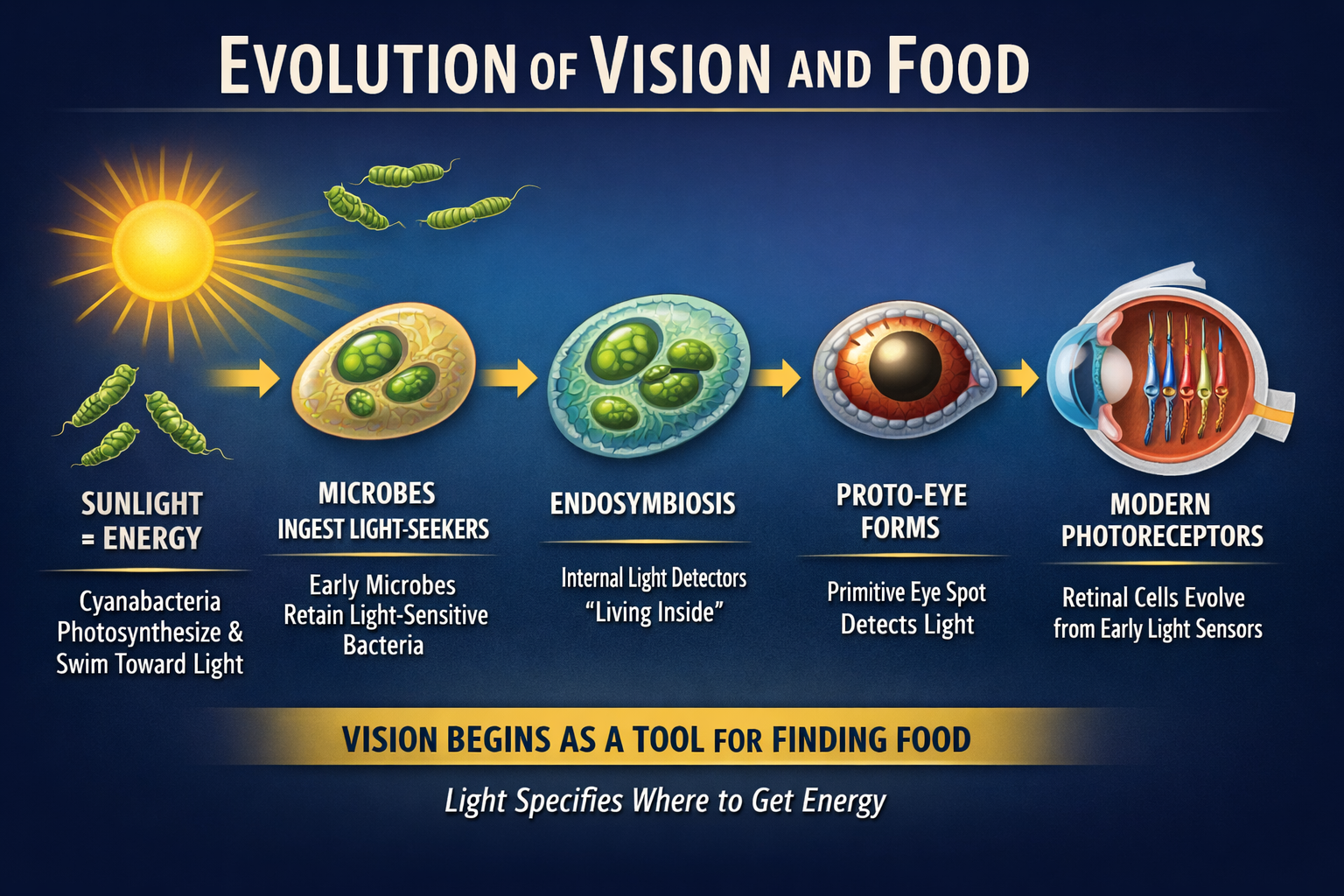
The ecological story of food perception begins long before animals, nervous systems, or even eyes existed. In his lecture Direct perception, affordances, and ecological realism (PJ Treffner, YouTube), the earliest organisms that interacted with light did so not to “see” in any representational sense, but to find food. Around two billion years ago, cyanobacteria—blue‑green algae—developed the ability to use sunlight to synthesise energy (56:40). These organisms were phototropes: they actively swam upward toward light because light directly specified the resource they needed to survive (56:56). In ecological terms, light was not a stimulus to be interpreted; it was an affordance—a directly perceivable opportunity for action.
This sets the stage for one of the most consequential evolutionary events in the history of perception. Other microbes consumed these light‑seeking cyanobacteria but did not digest them (57:18). Instead, they retained them internally as light detectors, using them to orient toward energy‑rich environments (57:48). Over immense evolutionary time, these internalised phototropic bacteria became the ancestors of the photoreceptors in modern retinas (1:16:15).
This evolutionary sequence illustrates a central ecological principle: perception does not begin with brains. Wächtershäuser’s theory of early life shows that organisms did not need neural tissue to “interpret” light (58:14). Light directly specified food (58:21). Perception began as direct awareness of life‑supporting resources, not as internal representation or cognition (59:34). The earliest “vision” was simply the detection of an affordance: move toward the light because the light is food.
Vision therefore did not begin as a tool for thinking; it began as a tool for action—specifically, for locating the energy that sustained life (59:43). The co‑evolution of photosynthesis and vision is not a coincidence but a deep ecological continuity: the first organisms to “see” were simply organisms that followed the light that fed them.
Reference
Treffner, P. J. (2014). Direct perception, affordances, and ecological realism, YouTube: https://www.youtube.com/watch?v=_bf3lQ95ghk&list=PLtoX6L88vjke4vpnevC7Gf9BWxNx3xbdU&index=8&t=3400s

Paul Treffner
metaffordance.com