Attention & ecological information
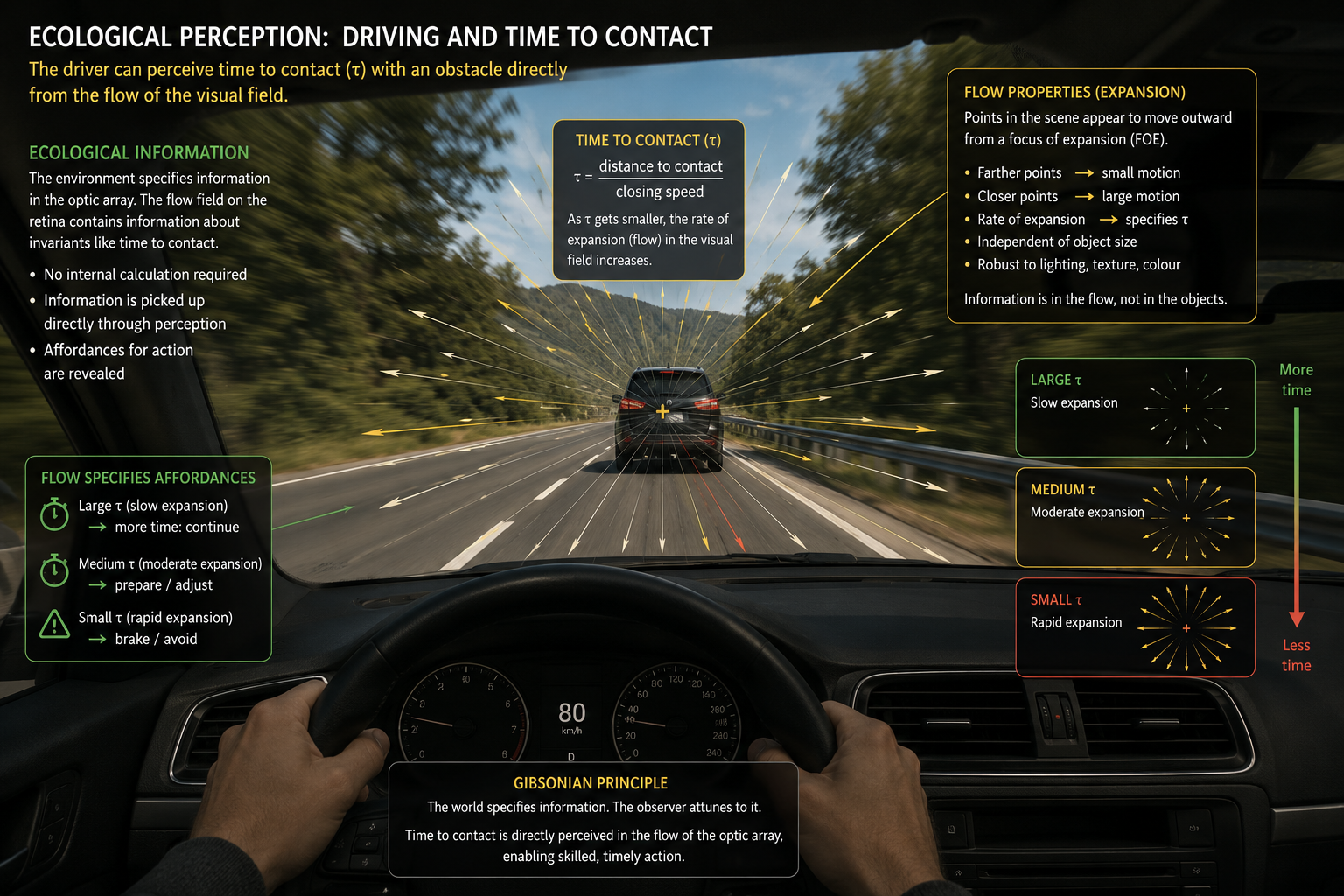
We are embedded in information...ecological information in the form of structured energy distributions - light, sound, and so on. When our exquisitely attuned perception-action system unconsciously detects the complex mathematical patterns in this environmental energy, it then constitutes information. This is the basis of our perception, attention, and action. Ecological information is the foundation of behaviour. Behaviour occurs in the world, not in the brain. The brain is part of the body, which is part of the world. Behaviour is the result of the interaction between the organism and the environment, based on the information available in that environment. This is a systems view of behaviour, not a reductionist view. Behaviour exists and is defined by the relation between the organism and the environment. To the extent that we can analyse this relation, we can then understand behaviour.
A classic example is time-to-contact information for driving, walking, or any kind of locomotion for any kind of organism. We directly see how long it will take for an object to contact us, or for us to contact an object, based on the rate of expansion of the optical structure in the environment (not retinal "images" - many organisms don't have retinas or images of any kind!). This is not a calculation in the brain; it's a direct perception of the affordances of contact, based on real (mathematical) structure in the light - the information. This is a powerful example of how we directly perceive the affordances of the environment - what Gibson meant by "direct perception"...perception of affordances, where affordances are the perceivable possibilities for action in the world.
Our studies include the world's first research using real driving in real cars (not a simulator) demonstrating how mobile phone conversations can impair attention, driving control, and safety. We also showed how postural stability is the foundation of improved attention, better perception, and safer driving. My research has also focused on multi-tasking, attention, and communication. Contrary to common belief, cognitive multitasking is only possible if one focusses attention on one topic at a time (or if they are cognitively unrelated). Switching between tasks is okay - but trying to do two things at once is inefficient and often impossible.
Attention, distraction, and safe driving are based on attention to - and detection of - information. This allows the perception of what actions the environment affords - the affordances of the environment. Information is detected; affordances are perceived.
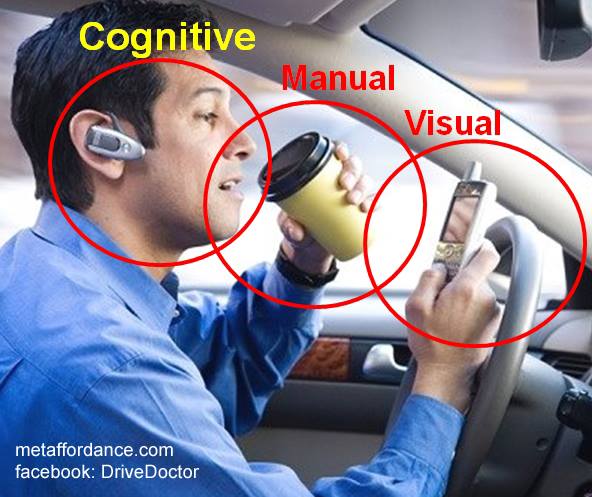
Key Findings
- World's first study of mobile phone distraction as measured in real cars (not a simulator)
- Hands-free phone conversations while driving degrade coordination and control
- Greater postural stability in skilled drivers → better perception and vehicle control
- Driver distraction: Is it that bad? Yes.
Workshops
- Available for workshops on attentive driving
- Since 2012, I have contributed talks and presentations to safe driving workshops on the topic of attentive driving for various NZ district councils including Waipa and Hamilton. I am available to provide these talks for driver education organisations, road safety organisations, and other groups interested in improving attention and safety in driving. I bring a unique perspective to this topic, based on our research in real cars and my understanding of the dynamics of perception-action systems.
-
Media coverage on workshops: Driving
courses
Treffner, P. J. (2018). Driver distraction – Is it that bad? Yes.
Invited talk plus workshop, 43rd annual conference of NZ Institute of Driver Educators
Phones and crashes in NZ
Publications: Driving stability, attention, and safety
Treffner, P. J. (2018). Driver distraction – Is it that bad? Yes. Invited talk plus workshop, 43rd annual conference of NZ Institute of Driver Educators.
LinkedIn version (with comments) PDFTreffner, P. J., & Barrett, R. (2004). Hands-free mobile phone speech while driving degrades coordination and control. Transportation Research, Part F: Traffic Psychology and Behaviour, 7, 229–246.
PDF Attentive driving videosTreffner, P. J., Barrett, R., & Petersen, A. J. (2002). Stability and skill in driving. Human Movement Science, 21, 749–784.
PDF Attentive driving videosTreffner, P. J., Barrett, R. S., Petersen, A. J., & White, R. (2002). Active stabilisation and perceptual sensitivity in safe driving. In Developing Safer Drivers and Riders: Proceedings of Travelsafe–Australian College of Road Safety Conference (pp. 91–104). Mawson, ACT: ACRS.
Conference award for best paper
PDFSee also: All publications